How to Choose a Stainless Steel Test Sieve: Mesh, Aperture & Material Guide
Wednesday August-26 2026 15:34:09
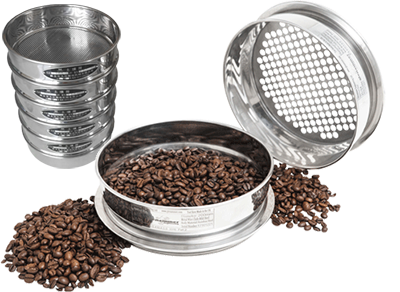
Choosing a stainless steel test sieve should start with the testing requirement rather than the mesh number alone. The main factors are aperture, mesh designation, wire diameter, frame material, sieve diameter, frame height, applicable standard, verification level, and equipment compatibility.
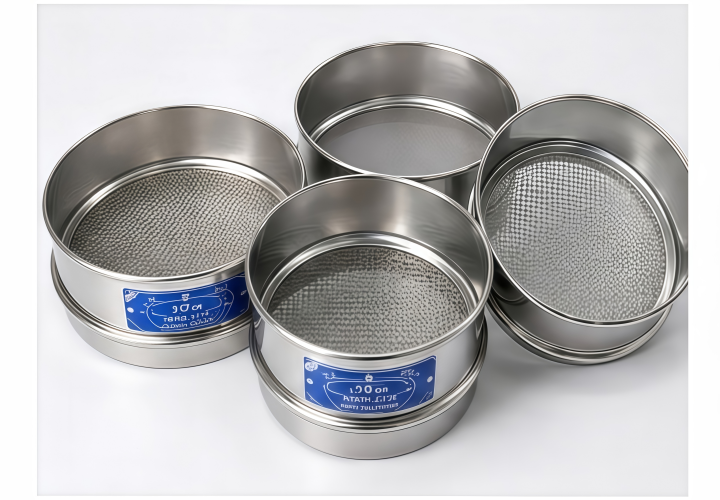
For routine laboratory purchasing, the correct sieve is the configuration that matches the test method, sample, material conditions, and existing equipment.
How to Choose Mesh, Aperture and Wire Diameter?
The nominal aperture should normally be the starting point when selecting a sieve for a defined particle-size separation.
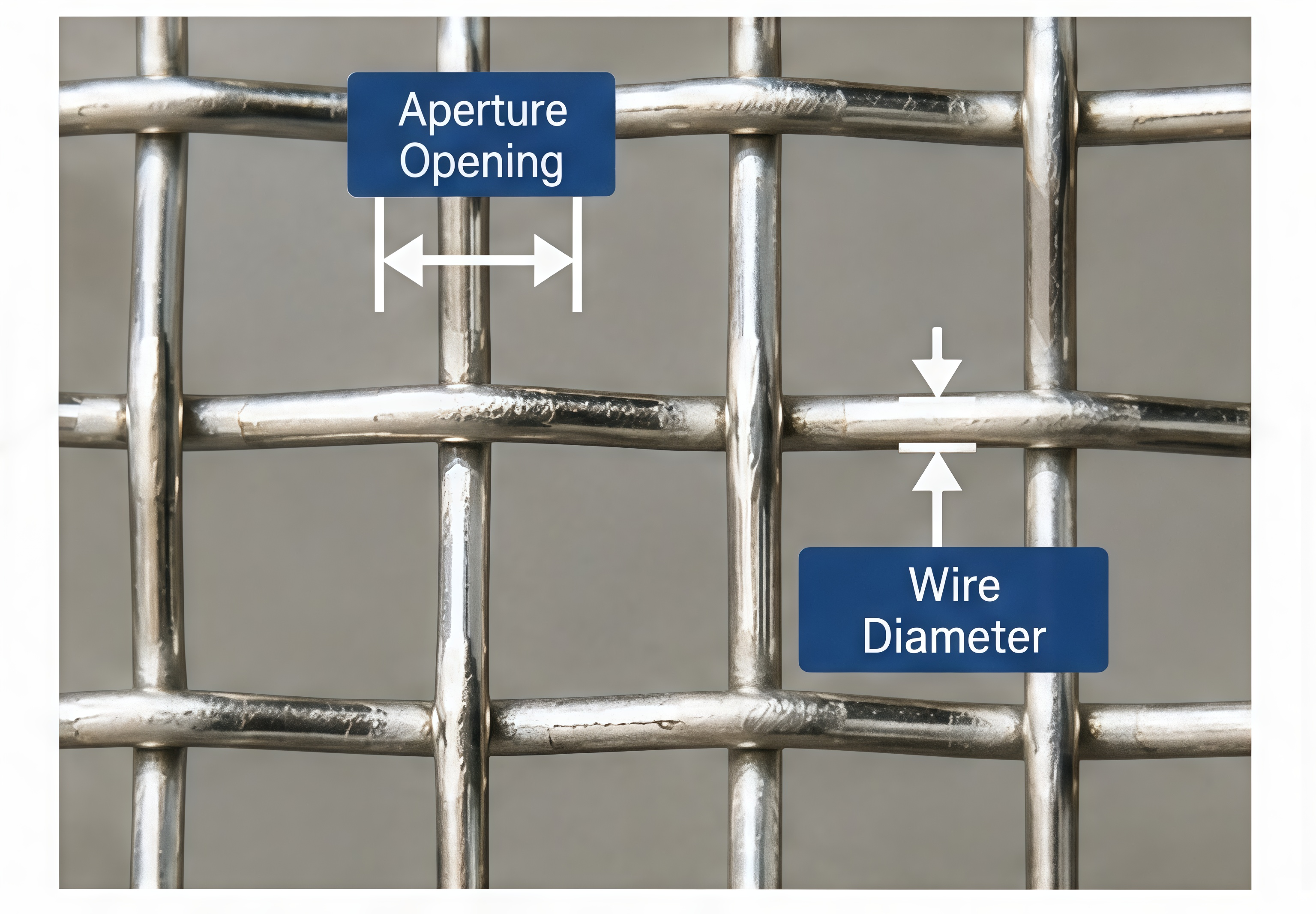
Mesh designation identifies a sieve series, while aperture describes the nominal opening of the woven wire cloth. Mesh number alone therefore does not provide the complete specification.
Wire diameter also affects the resulting opening and available open area, so two sieves with similar mesh designations should not automatically be treated as identical.
| Parameter | What to Check |
|---|---|
| Particle size | Required separation range |
| Nominal aperture | Required opening |
| Mesh designation | Applicable sieve designation |
| Wire diameter | Woven-wire construction |
| Standard | Required testing specification |
For a separation around 150 μm, first confirm the nominal aperture required by the test method and applicable standard, then confirm the corresponding sieve designation and wire diameter.
A complete purchasing specification should ideally include:
ASTM E11-24 covers woven wire test sieve cloth and test sieve construction, including sieve openings, frame sizes, and inspection procedures.
For a broader ASTM sieve-size reference, you can also see the ASTM E11 test sieve size and mesh selection guide.
How to Choose SS304 or SS316/316L?
Material selection should be based on the tested material, cleaning process, chemical exposure, and laboratory or customer requirements.
SS304 is suitable for many general laboratory and industrial applications where demanding corrosion resistance is not required.
SS316 or SS316L can be considered when the testing environment requires greater corrosion resistance, including certain chemical or chloride-containing conditions.
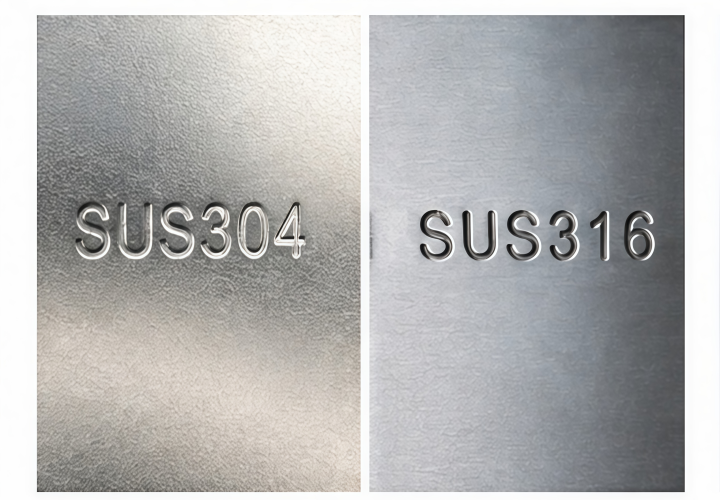
| Factor | SS304 | SS316/316L |
|---|---|---|
| General laboratory use | Common choice | Suitable |
| Routine material testing | Suitable | Suitable |
| More corrosive conditions | Evaluate application | Often considered |
| Chloride exposure | Requires evaluation | Often preferred |
| Relative cost | Generally lower | Generally higher |
The practical rule is to select the stainless steel grade according to the actual testing environment rather than assuming that the higher grade is always necessary.
How to Choose Sieve Diameter, Frame Height and Equipment Compatibility?
Sieve diameter should not be selected from particle size alone.
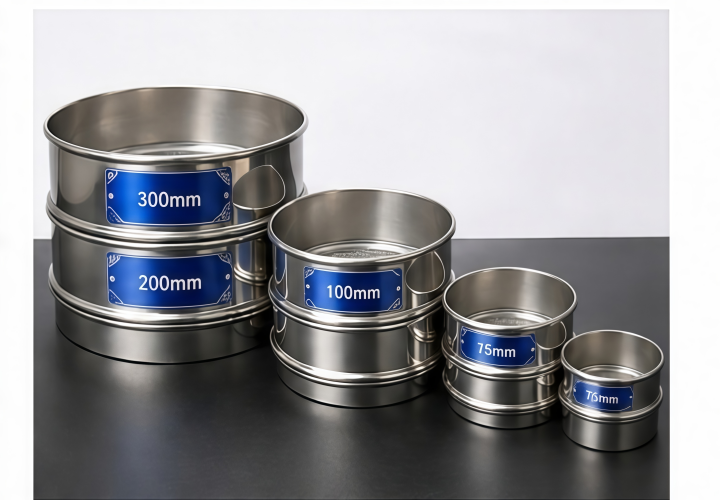
Particle size helps determine aperture, while sample quantity, available screening area, frame configuration, and equipment compatibility help determine diameter.
Common laboratory configurations include 75 mm, 100 mm, 200 mm, and 300 mm diameters.
| Diameter | Typical Consideration |
|---|---|
| 75 mm | Small laboratory samples |
| 100 mm | Small-volume testing |
| 200 mm | Common laboratory configuration |
| 300 mm | Larger sample quantities and screening area |
Frame height becomes important when several sieves are stacked. Before ordering or replacing a sieve, check the existing sieve diameter, available stack height, support or clamping dimensions, and the number of sieves required.
A sieve can have the correct aperture but still be unsuitable if its frame does not fit the existing equipment.
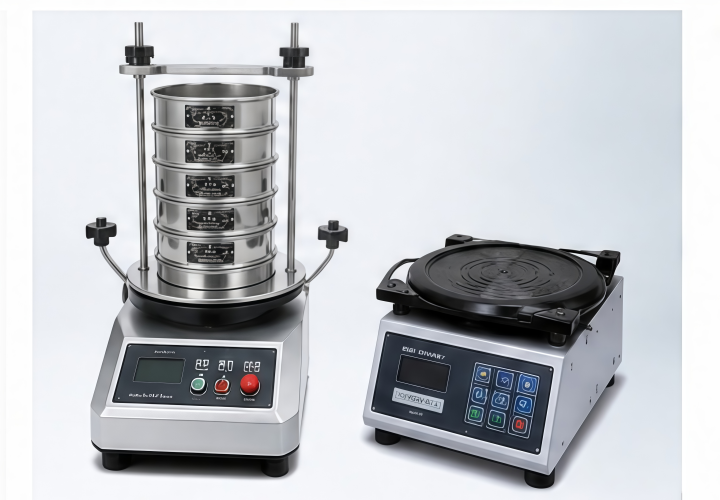
If the sieve will be used with a shaker, confirm compatibility before ordering. For example, Dahan's electromagnetic sieve shaker supports multiple test sieve layers, while its laboratory sieve shaker is designed for routine laboratory particle-size testing.
How to Choose ASTM E11-24, ISO 3310-1 and Verification Level?
The applicable standard should be confirmed before the final specification is issued.
Select ASTM E11 when the laboratory method or customer requirement calls for an ASTM test sieve. Select the relevant ISO specification when the testing method or customer requirement calls for an ISO test sieve.
ASTM and ISO specifications should not be treated as interchangeable simply because two nominal apertures appear similar. The standard specified by the testing method should control the selection.
| Requirement | Select |
|---|---|
| ASTM test method | Corresponding ASTM sieve |
| ISO test method | Corresponding ISO sieve |
| Customer specification | Stated customer standard |
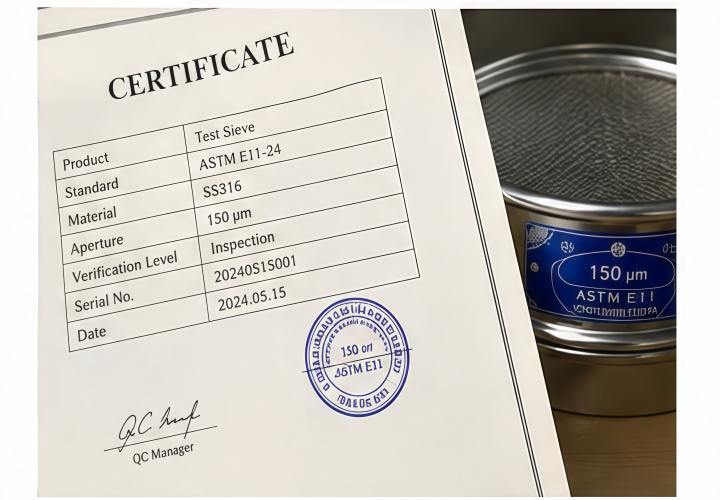
ASTM E11 test sieves are commonly supplied in Compliance, Inspection, or Calibration grades. Higher verification levels are used when greater opening verification or measurement documentation is required.
| Verification Level | Typical Use |
|---|---|
| Compliance | Routine conformity |
| Inspection | Additional verification of sieve openings |
| Calibration | Higher level of measurement information |
The required verification level should follow the testing method and laboratory quality requirements.
What Should You Check Before Buying?
Before purchasing a stainless steel test sieve, check the sieve identification, nominal aperture, wire diameter, frame dimensions, material, applicable standard, and verification documentation.
For laboratory applications, clear sieve identification and appropriate test documentation can make replacement, traceability, and quality control easier.
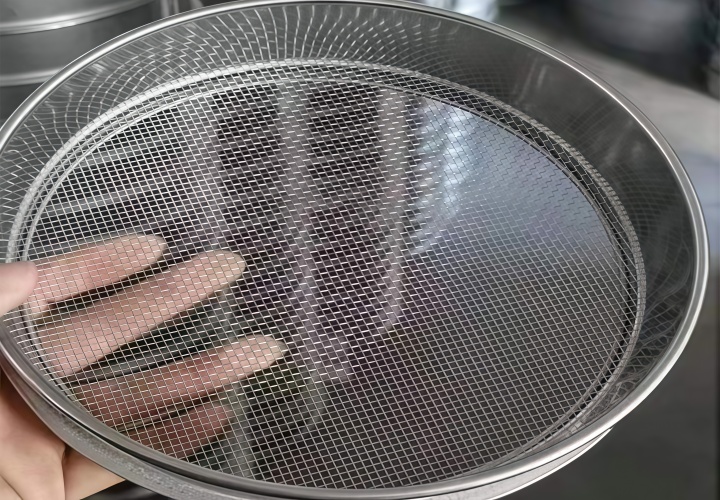
The sieve cloth should be evenly tensioned and securely mounted to the frame, with no obvious damage or visible defects.
Stainless Steel Test Sieve Selection Checklist
Before requesting a quotation, prepare the following information:
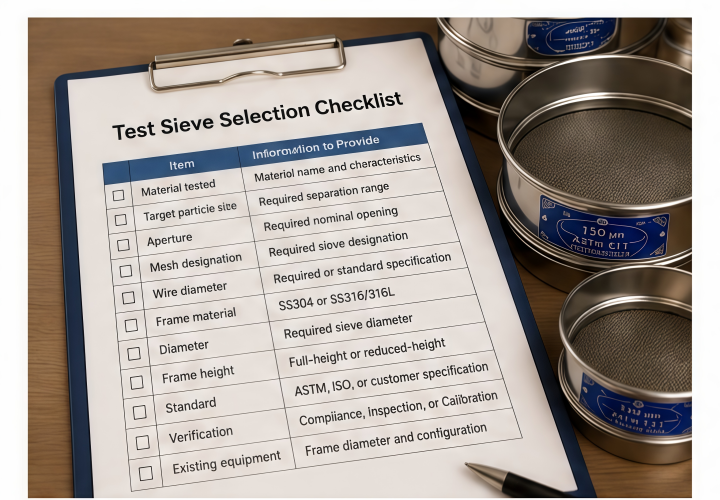
| Item | Information to Provide |
|---|---|
| Material tested | Material name and characteristics |
| Target particle size | Required separation range |
| Aperture | Required nominal opening |
| Mesh designation | Required sieve designation |
| Wire diameter | Required or standard specification |
| Frame material | SS304 or SS316/316L |
| Diameter | Required sieve diameter |
| Frame height | Full-height or reduced-height |
| Standard | ASTM, ISO, or customer specification |
| Verification | Compliance, Inspection, or Calibration |
| Existing equipment | Frame diameter and configuration, if applicable |
For a replacement order, existing sieve dimensions can be as important as the mesh designation.
You can also review Dahan's test sieve range when comparing different sieve materials, configurations, and standards.
Frequently Asked Questions
How do I choose the right mesh size for a stainless steel test sieve?
Start with the required nominal aperture from the test method, then confirm the corresponding sieve designation, wire diameter, and standard. Do not select the sieve by mesh number alone.
Should I choose SS304 or SS316?
SS304 is suitable for many general applications. SS316 or SS316L can be considered when the tested material, cleaning process, or operating environment requires greater corrosion resistance.
Which verification level should I choose?
Follow the testing method or laboratory quality requirements. Compliance may suit routine conformity checks, while Inspection or Calibration can be appropriate when additional opening measurements or documentation are required.
Final Decision

The correct stainless steel test sieve is not necessarily the finest mesh or largest frame. It is the configuration that matches the required particle-size separation, aperture, wire diameter, material, dimensions, applicable standard, verification level, and equipment.
If you are requesting a quotation, provide the material being tested, target particle-size range, required aperture or mesh, applicable standard, sieve diameter, verification level, and existing equipment dimensions.
Need help selecting a stainless steel test sieve?
Send the material, target particle size, aperture or mesh, sieve diameter, applicable standard, and verification requirement. Dahan can review these parameters and recommend a suitable stainless steel test sieve configuration.
View Standard Test Sieve | View Test Sieves | Request Technical Support
Do you want to know the output? model? price? Please click (inside product page) or online consultation to learn more.
Dahan can also customize it for you according to your needs. Come and get the design that suits you.
Kon Leung, Ph.D.
Staff Simulation Engineer at BISSELL Homecare, Inc.