Particle Size Analysis Using Test Sieves: Methods & Sieve Sizes
Saturday August-22 2026 11:14:52
Particle Size Analysis Using Test Sieves: Methods & Sieve Sizes
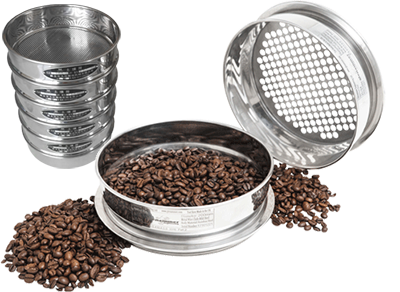
Particle size analysis using test sieves is a practical method for separating powders and granular materials into different particle-size ranges according to sieve aperture. It is widely used for laboratory testing, quality control, material classification, and production control.
The basic process is to pass a representative sample through sieves with known apertures, weigh the material retained on each sieve, and calculate the particle size distribution. Reliable results depend on suitable sieve selection, representative sampling, controlled screening, accurate weighing, and correct calculation.
What Is Particle Size Analysis?
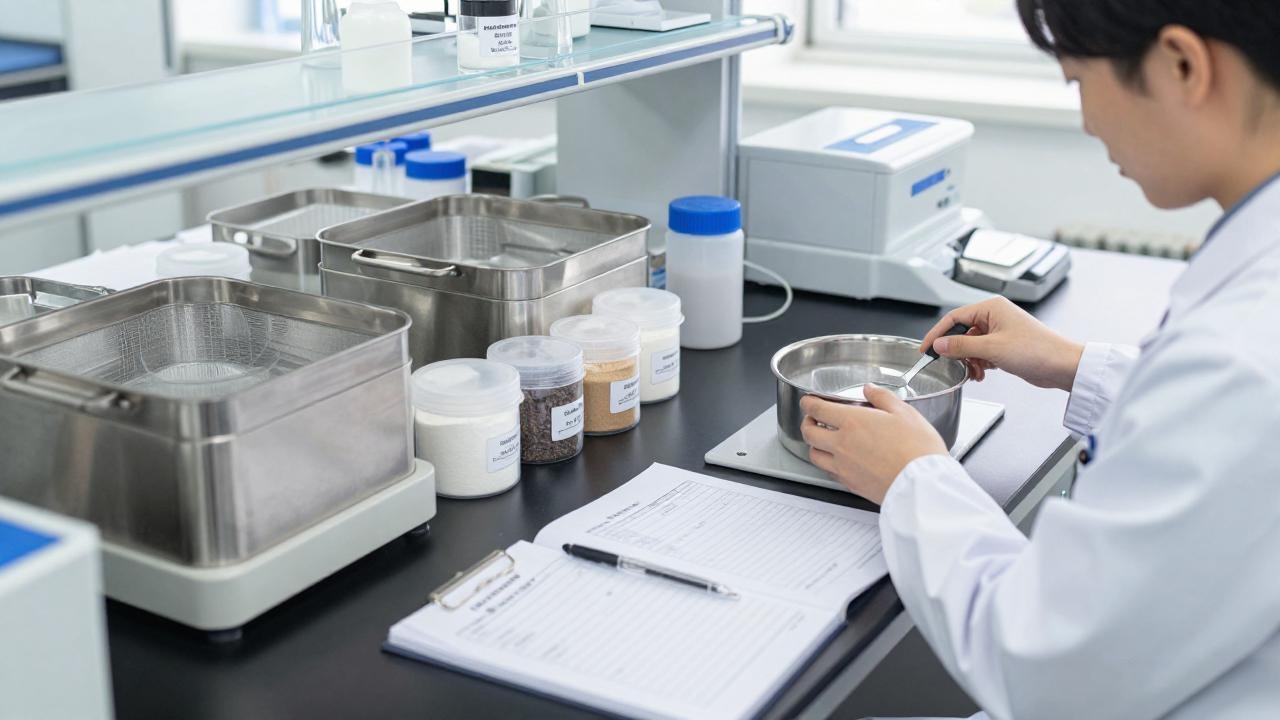
Particle size analysis determines how particles in a material are distributed across different size ranges.
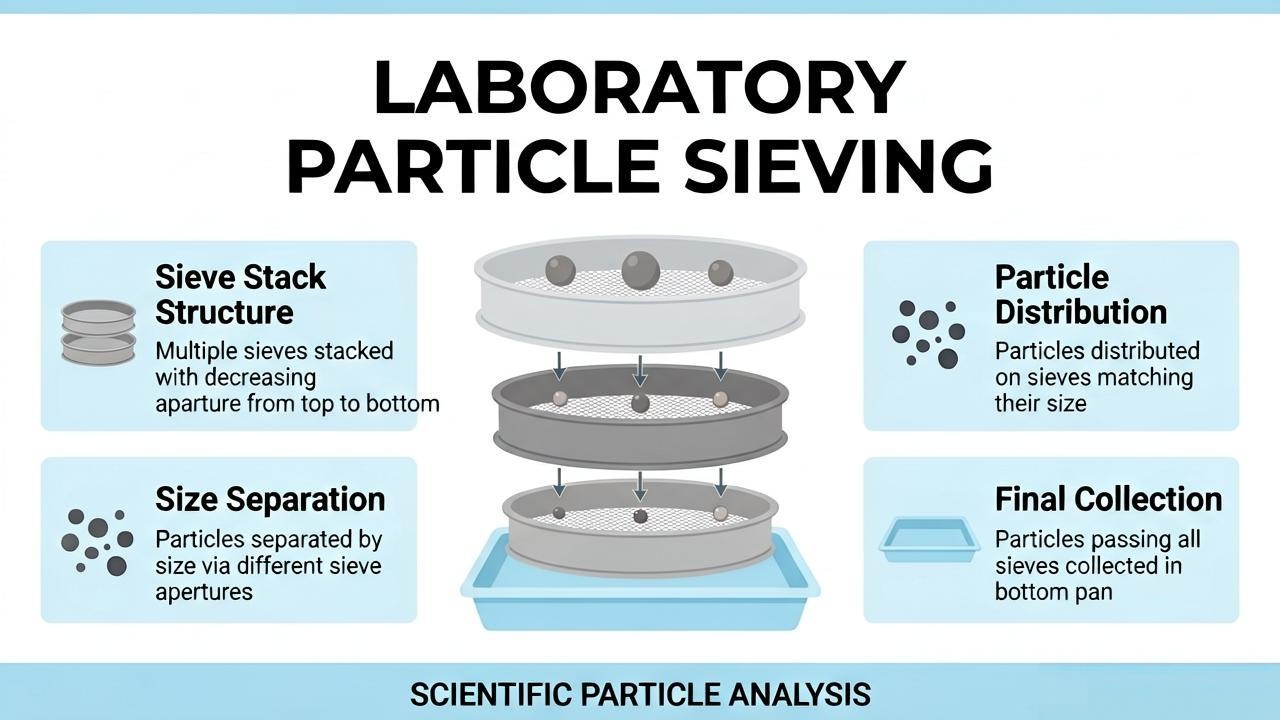
During sieve analysis, larger particles are retained on coarser sieves while smaller particles pass through finer sieves and into the receiving pan. The retained material is weighed and expressed as a percentage of the original sample mass.
The resulting particle size distribution can be used to evaluate material consistency, classify particles, monitor production, and compare a material with a specified grading requirement.
Equipment Required for Sieve Analysis
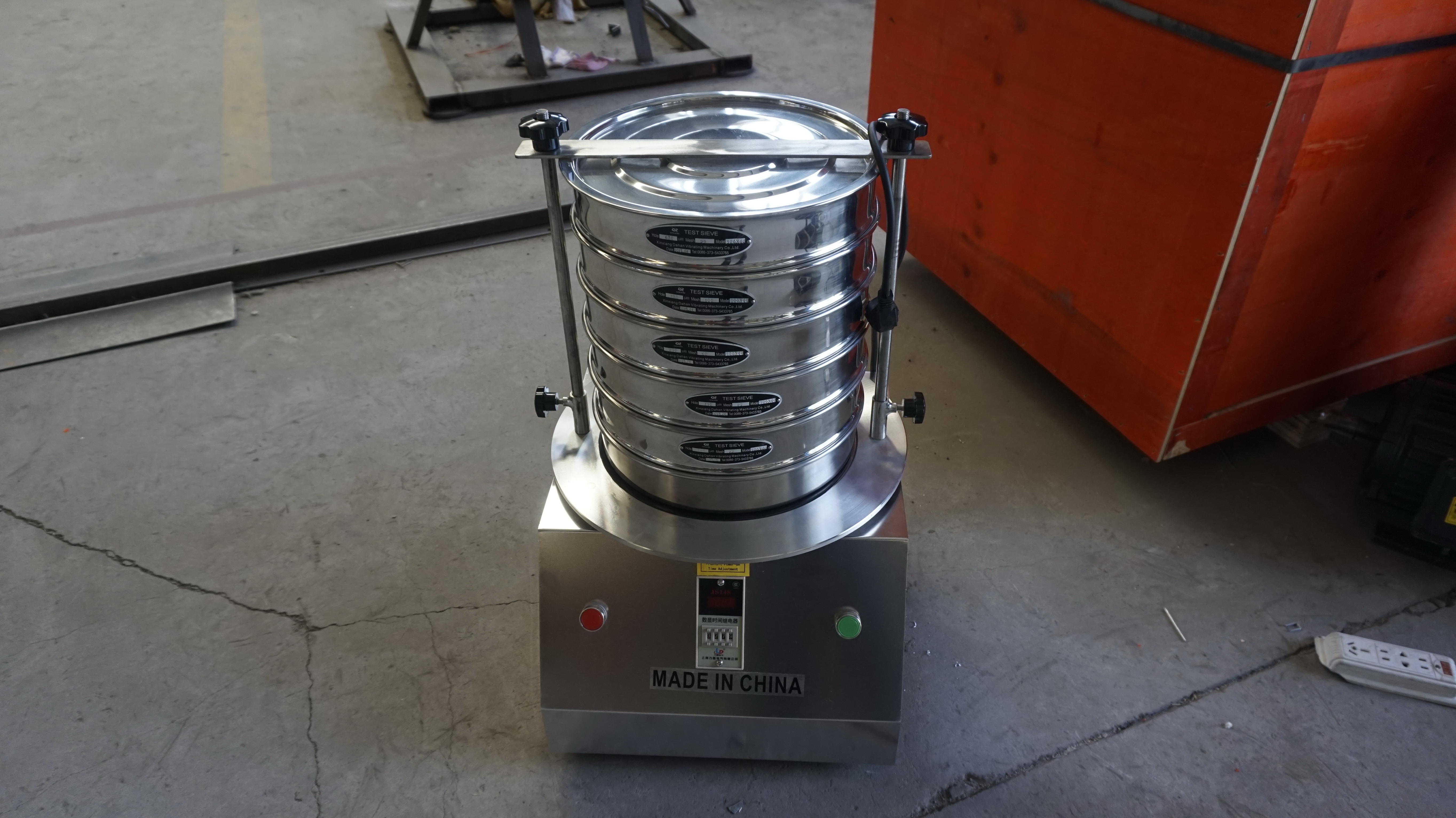
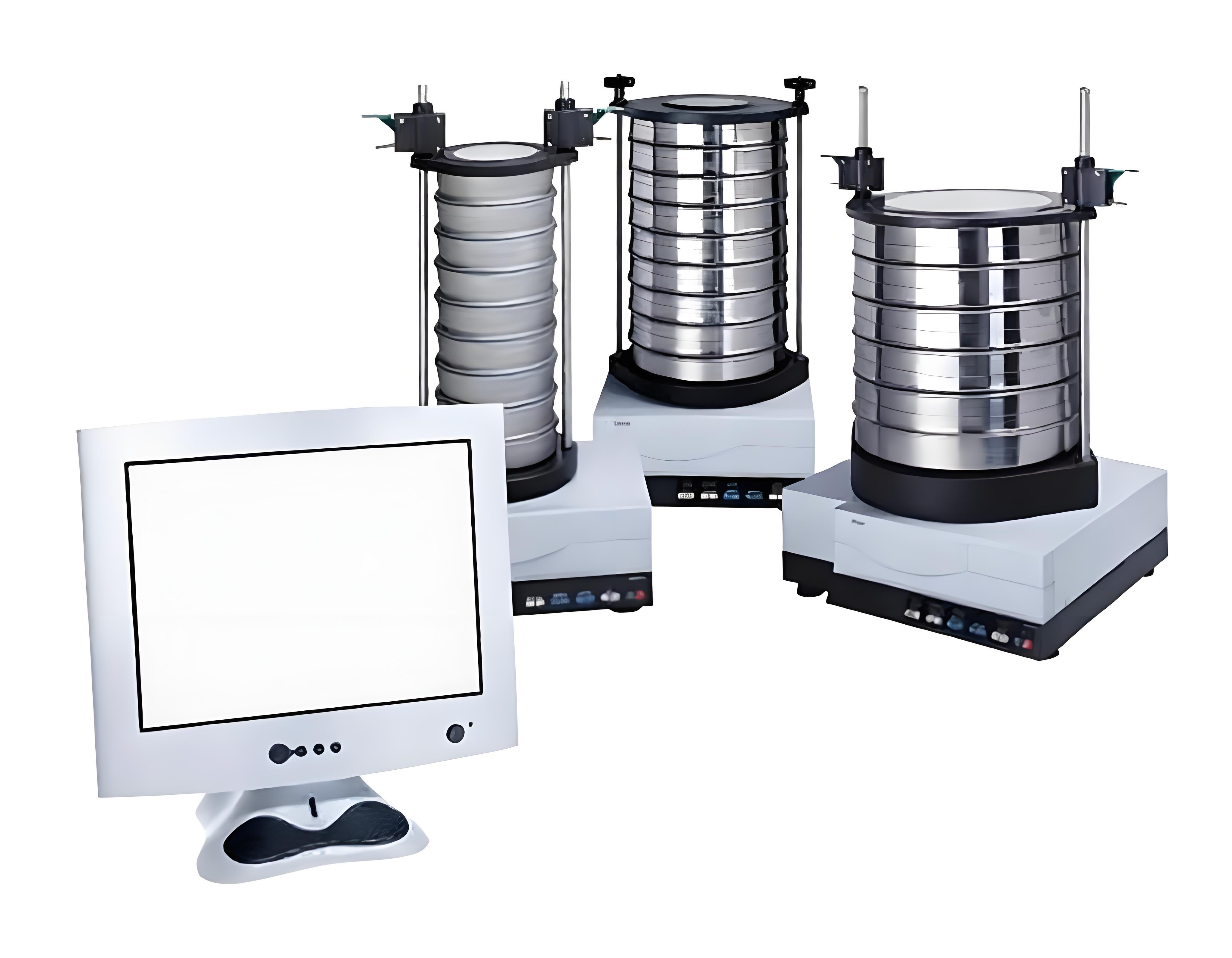
A typical test sieve analysis requires suitable test sieves, a receiving pan and lid, a balance, and, for controlled screening, a sieve shaker.
The appropriate equipment depends on the material, particle-size range, sample quantity, sieve diameter, and applicable testing method.
How to Perform Particle Size Analysis Using Test Sieves?
1. Prepare the Sample
The sample should represent the material being tested. Moisture, segregation, and agglomeration can affect the measured particle-size distribution.
The required sample quantity should follow the applicable test method. Excessive loading should be avoided because a thick layer of material can reduce separation efficiency.
2. Select the Test Sieves
Select sieve apertures according to the expected particle-size range, required resolution, and testing objective.
A standard test sieve provides a defined aperture for laboratory particle-size testing.
For a complete particle size distribution, several progressively smaller apertures are normally used. A single sieve or smaller sieve set may be sufficient for a simple size check.
3. Arrange the Sieve Stack
Place the sieve with the largest aperture at the top and progressively smaller apertures below it. Place the receiving pan beneath the finest sieve.
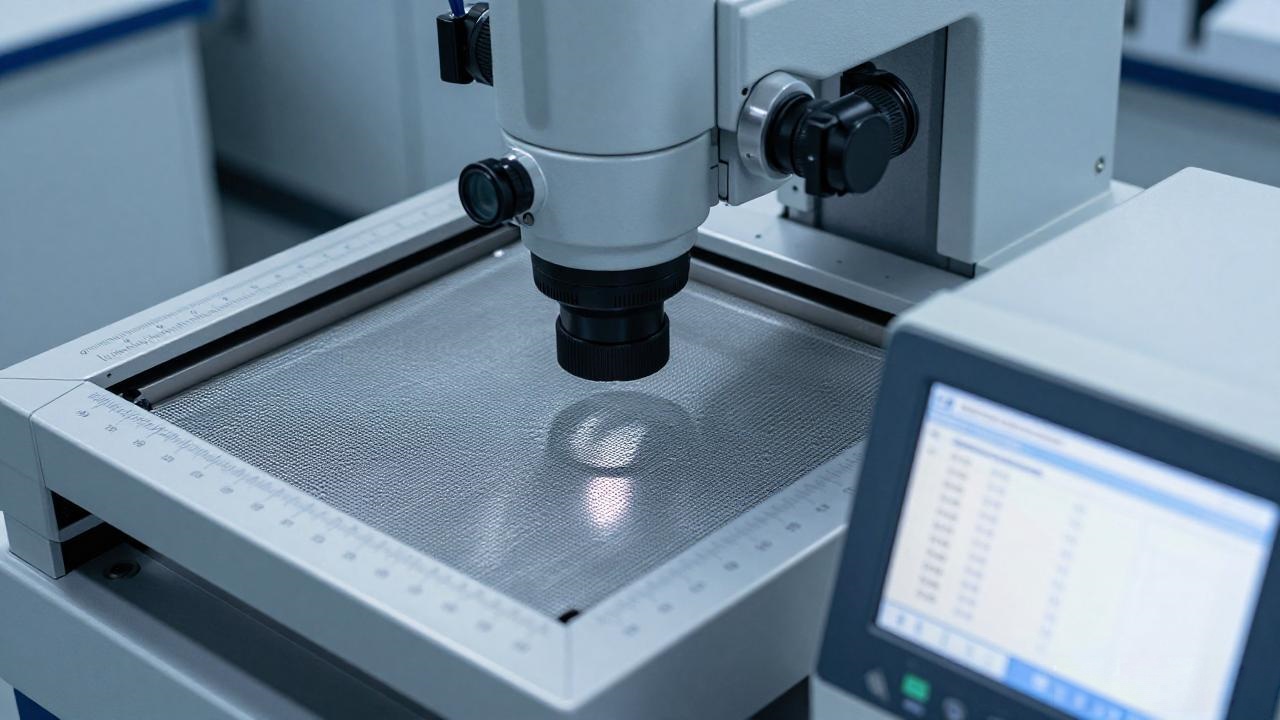
4. Sieve the Sample
Place the prepared sample on the top sieve and screen it according to the applicable test method.
Manual sieving can be suitable for simple tests, while a mechanical sieve shaker provides controlled movement and more repeatable screening conditions.
Sieve time should follow the applicable test method. For routine testing, the endpoint can be established by checking whether additional sieving produces a meaningful change in retained mass.
5. Weigh the Retained Material
After screening, collect and weigh the material retained on each sieve and in the receiving pan.
The total recovered mass should be reasonably close to the original sample mass. A significant difference may indicate material loss, dust loss, transfer loss, or incomplete recovery.
6. Calculate Particle Size Distribution
The percentage retained on a sieve can be calculated as:
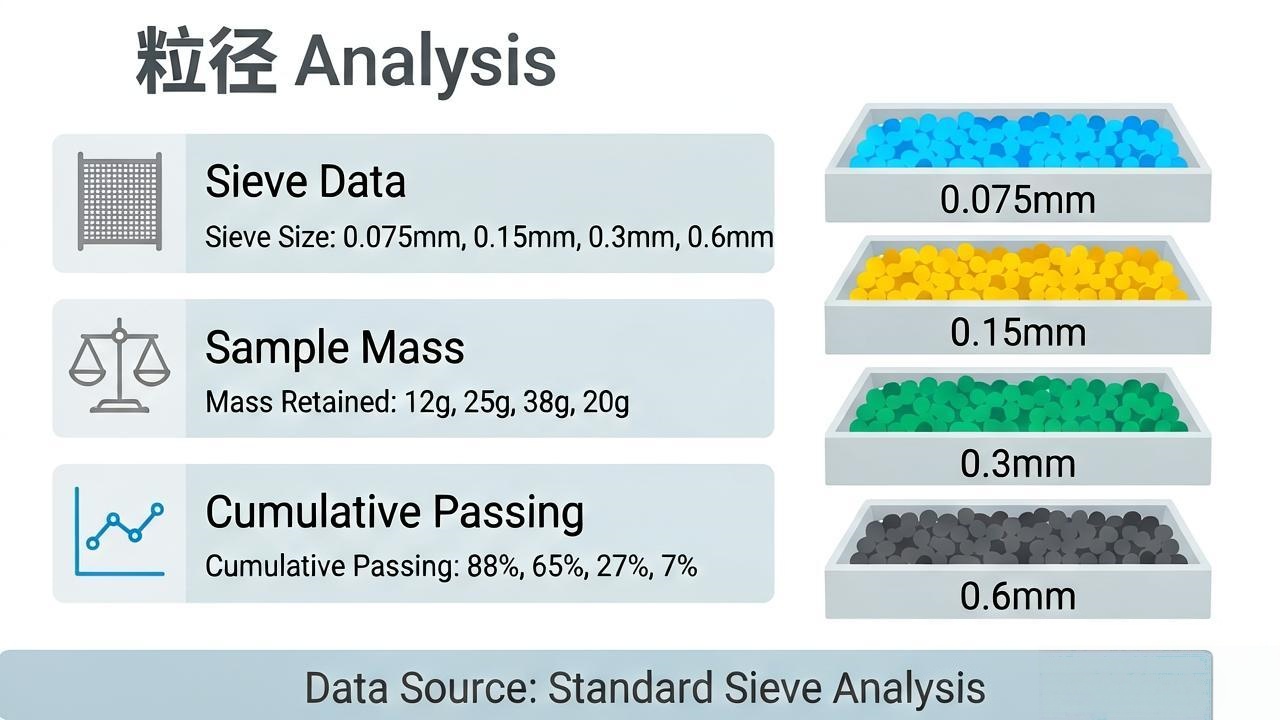
Percentage Retained (%) = Mass Retained ÷ Original Sample Mass × 100
For example, if a 500 g sample leaves 75 g on one sieve:
75 ÷ 500 × 100 = 15% retained
Percentage passing can then be calculated from the cumulative percentage retained:
Percentage Passing (%) = 100 − Cumulative Percentage Retained
The results can be arranged in a table or plotted as a particle size distribution curve.
Sieve Size, Aperture and Mesh Number
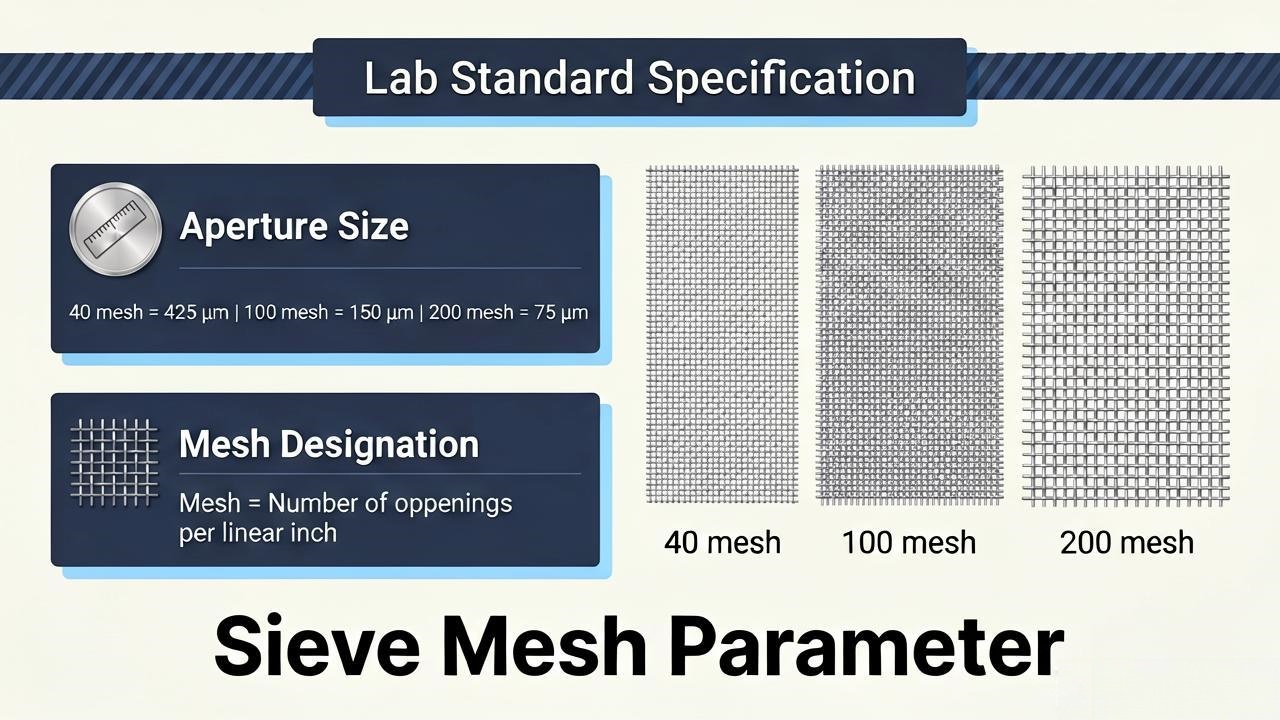
Sieve aperture is one of the most important factors in particle size analysis using test sieves.
The aperture is the actual opening through which particles pass. Mesh number is a sieve designation and should not be treated as a direct substitute for aperture size.
Because wire diameter affects the relationship between mesh designation and opening size, accurate testing should be based on the required aperture and applicable sieve standard.
For detailed sieve sizes and aperture information, see the standard test sieve sizes and apertures.
How Many Test Sieves Do You Need?
The number of sieves depends on the expected particle-size range and required resolution. A single sieve may be sufficient for a simple size check, while several progressively smaller apertures are normally used for a complete particle size distribution.
ASTM E11-24 Test Sieve Requirements
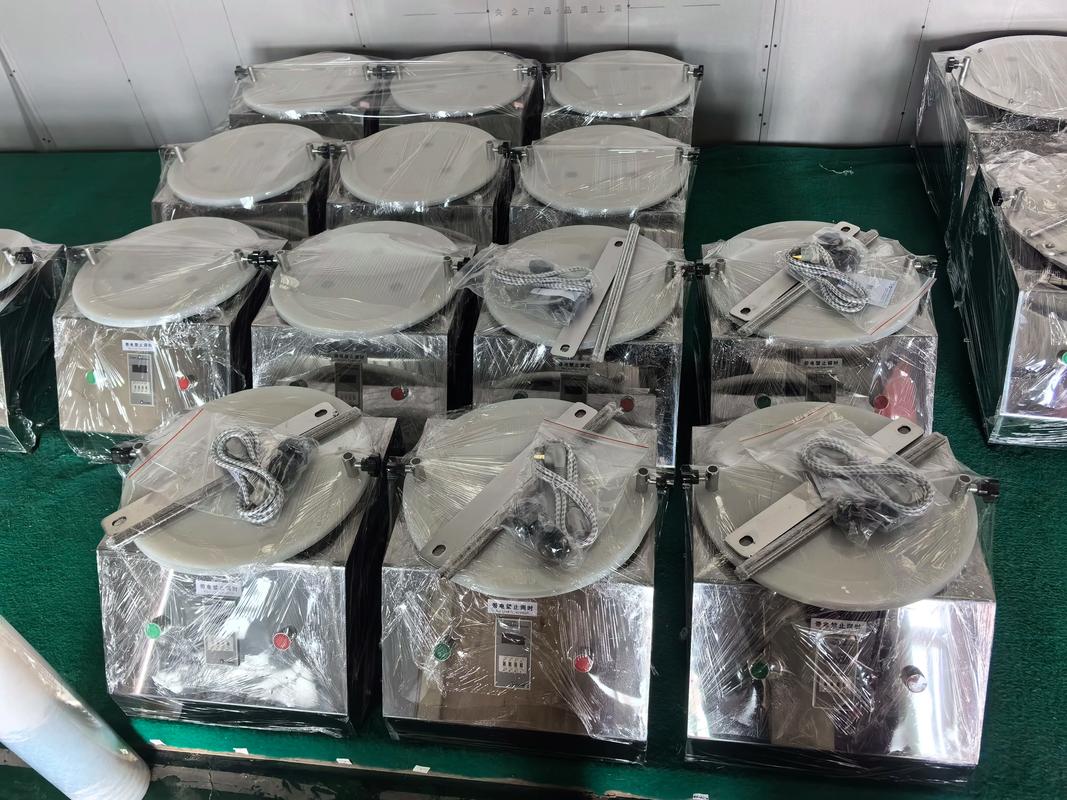
ASTM E11-24 is widely referenced for laboratory test sieve requirements. It addresses test sieve construction and wire cloth requirements, while the actual particle-size analysis procedure depends on the material and applicable test method.
Therefore, particle size analysis with test sieves should consider both the required sieve specification and the appropriate testing procedure.
For ASTM-related requirements, see the ASTM E11 test sieve standard guide.
How to Interpret Sieve Analysis Results?
The material retained on each sieve represents a particular particle-size fraction.
Percentage retained shows the proportion of the sample remaining on a specific sieve, while percentage passing shows the proportion that has passed through that aperture.
A typical result can be organized as:
| Sieve | Aperture | Mass Retained | % Retained | % Passing |
|---|---|---|---|---|
| Sieve 1 | Larger | — | — | — |
| Sieve 2 | Medium | — | — | — |
| Sieve 3 | Smaller | — | — | — |
| Pan | — | — | — | — |
The results can then be plotted as a particle size distribution curve and compared with a required grading range or specification.
When Is Sieve Analysis Suitable?
Sieve analysis is suitable for many powders, granules, aggregates, soils, and other particulate materials that can be effectively separated through the selected apertures.
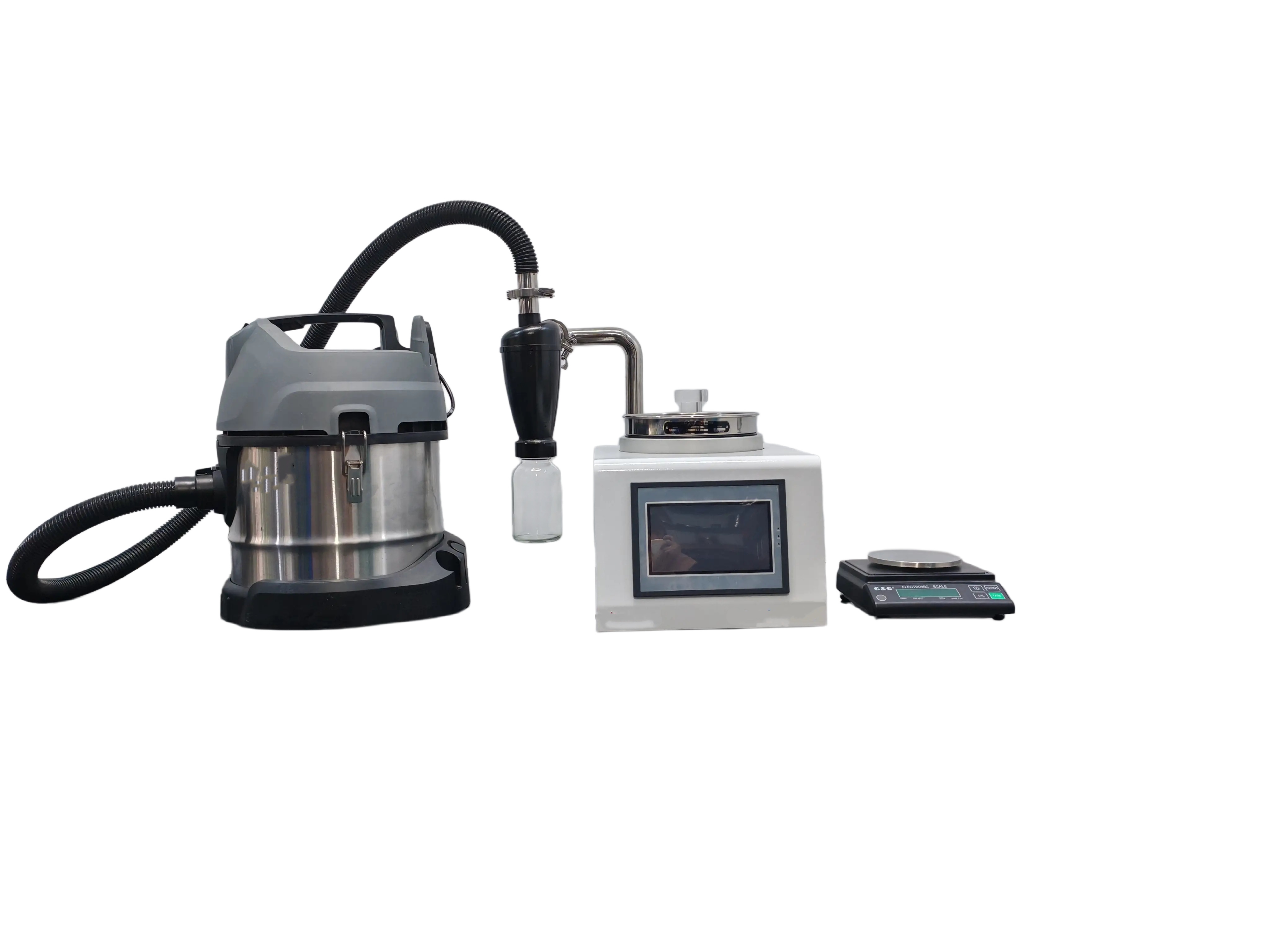
Extremely fine, cohesive, electrostatic, or strongly agglomerated materials may require wet sieving, air-jet sieving, micromesh sieves, ultrasonic assistance, or another particle-sizing method.
The appropriate method depends on particle size, material properties, sample condition, and the applicable test procedure.
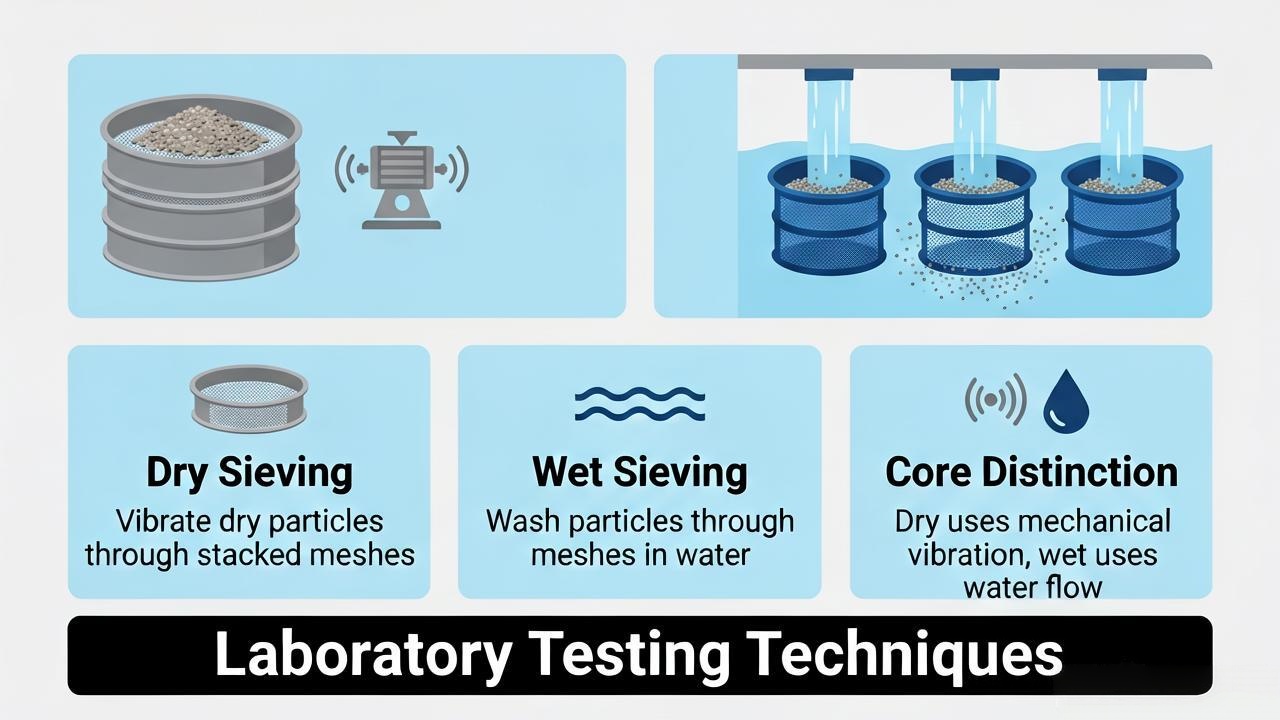
Dry Sieving vs. Wet Sieving
Dry sieving is generally suitable for dry and relatively free-flowing materials.
Wet sieving can be useful when fine particles agglomerate during dry screening or when washing is required by the applicable test method.
| Material or Condition | Suitable Approach |
|---|---|
| Dry, free-flowing material | Dry sieving |
| Fine particles prone to agglomeration | Consider wet or assisted sieving |
| Material requiring washing | Wet sieving |
| Very fine or difficult-to-screen material | Consider an appropriate fine-particle method |
Choosing a Sieve Shaker for Particle Size Analysis
A sieve shaker provides controlled movement to a stack of test sieves and can improve consistency when repeated laboratory testing is required.
Mechanical Sieve Shaker
A mechanical sieve shaker is suitable for routine particle-size testing where several test sieves require controlled movement.
Electromagnetic Sieve Shaker
An electromagnetic sieve shaker can be considered when controlled and repeatable screening conditions are required.
Ultrasonic Sieve Shaker
An ultrasonic sieve shaker can be useful for fine powders affected by mesh blockage, electrostatic effects, or agglomeration during conventional screening.
How to Choose the Right Sieve Shaker
Particle size range: Determine whether the material is coarse, fine, or difficult to screen.
Material characteristics: Cohesive, electrostatic, or easily agglomerated powders may require assisted screening.
Sieve diameter and number: The shaker should match the required sieve diameter and number of sieves.
Testing requirements: Routine testing may require repeatable mechanical screening, while difficult fine-powder applications may benefit from assisted sieving.
Common Problems During Sieve Analysis
| Problem | Possible Cause |
|---|---|
| Sieve blinding | Fine particles block sieve openings |
| Agglomeration | Small particles form larger clusters |
| Static electricity | Fine dry powders resist movement |
| Excessive loading | Too much material covers the sieve surface |
| Poor separation | Sieve range or method is unsuitable |
These problems are better addressed through sample preparation, sieve selection, loading control, and appropriate screening conditions rather than simply increasing shaking intensity.
Conclusion
Particle size analysis using test sieves provides a practical method for determining particle size distribution in many powders and granular materials. Reliable results depend on suitable sieve apertures, representative sampling, controlled screening, and accurate weighing.
For sieve or sieve shaker selection, provide the material type, expected particle-size range, sample quantity, sieve diameter, and applicable testing standard so that a suitable sieve configuration and screening method can be recommended.
Frequently Asked Questions
What is particle size analysis using test sieves?
It is a method of separating particulate material through sieves with known apertures and measuring the material retained on each sieve to determine particle size distribution.
How do I choose the right test sieve size?
Choose the aperture according to the expected particle-size range, testing objective, and applicable standard. Several progressively smaller apertures are normally used for a complete distribution.
What is the difference between mesh size and sieve aperture?
Mesh is a sieve designation, while aperture is the actual physical opening. Accurate testing should be based on the required aperture rather than mesh number alone.
When should I use a sieve shaker?
A sieve shaker is useful when controlled and repeatable movement is required, especially when several test sieves are used for laboratory particle-size analysis.
When is ultrasonic sieving useful?
Ultrasonic assistance can be useful for fine powders affected by mesh blockage, electrostatic effects, or agglomeration during conventional sieving.
Do you want to know the output? model? price? Please click (inside product page) or online consultation to learn more.
Dahan can also customize it for you according to your needs. Come and get the design that suits you.
Kon Leung, Ph.D.
Staff Simulation Engineer at BISSELL Homecare, Inc.