Wire Mesh Test Sieve: Mesh Size, Aperture and Selection Guide
Thursday August-27 2026 10:49:07
Wire Mesh Test Sieve: Mesh Size, Aperture and Selection
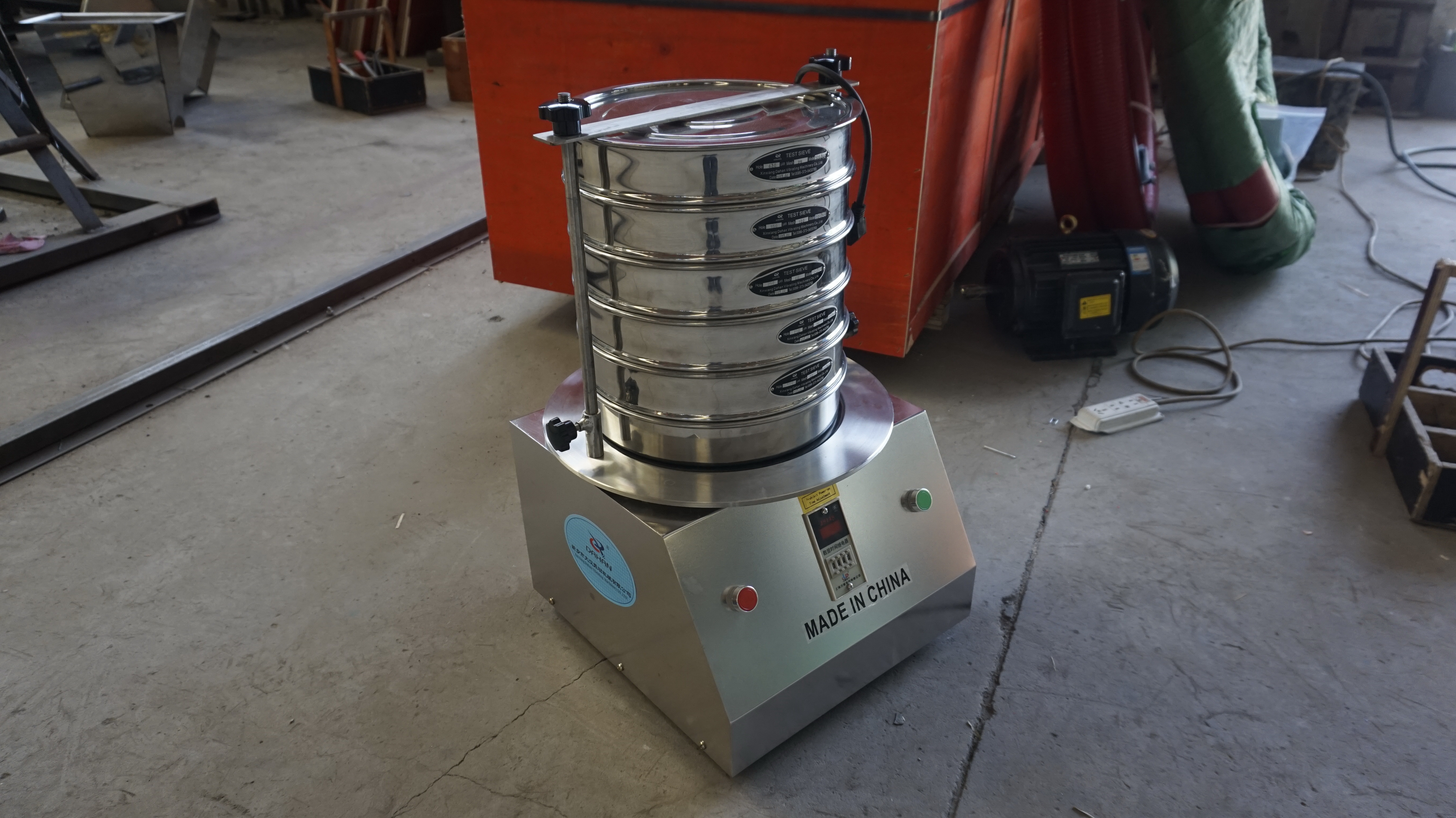
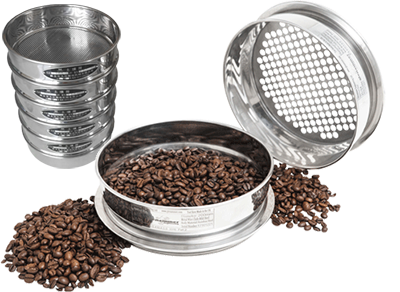
A wire mesh test sieve uses woven wire mesh and a rigid frame to separate particles according to size. The nominal aperture defines the intended opening size, while mesh number provides a general reference. Wire diameter, sieve standard, sieve diameter, and construction should also be considered when selecting a sieve for particle size analysis.
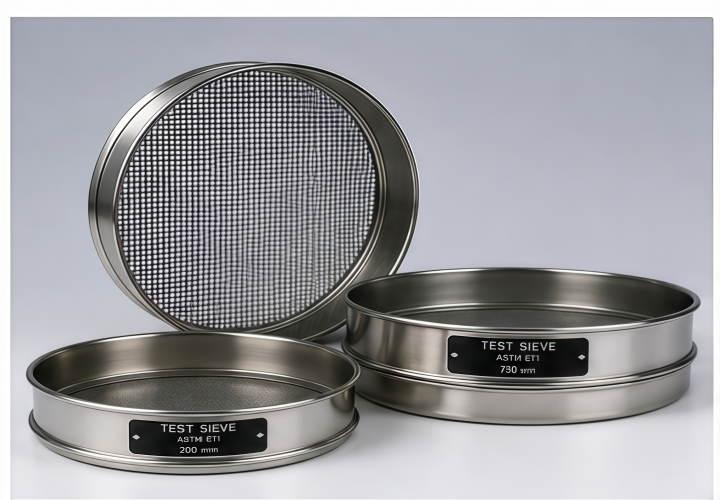
This guide explains the relationship between mesh size, aperture, and micron values and shows how to select the appropriate sieve for laboratory testing and quality control.
Mesh Size vs. Nominal Aperture
What Does Mesh Size Mean?
Mesh size generally refers to the number of openings per linear inch of woven wire mesh. A higher mesh number normally corresponds to smaller openings.
For example, a 200 mesh screen has smaller openings than a 40 mesh screen. Mesh number is therefore useful as a general reference when discussing sieve sizes.
However, mesh number alone does not completely define the opening because wire diameter also affects the mesh geometry.
What Is Nominal Aperture?
Nominal aperture is the specified clear opening between adjacent wires and is usually expressed in millimeters or micrometers (μm).
For particle size analysis, aperture is usually more useful than mesh number because it directly defines the intended particle separation size.
A simple way to understand the specifications is:
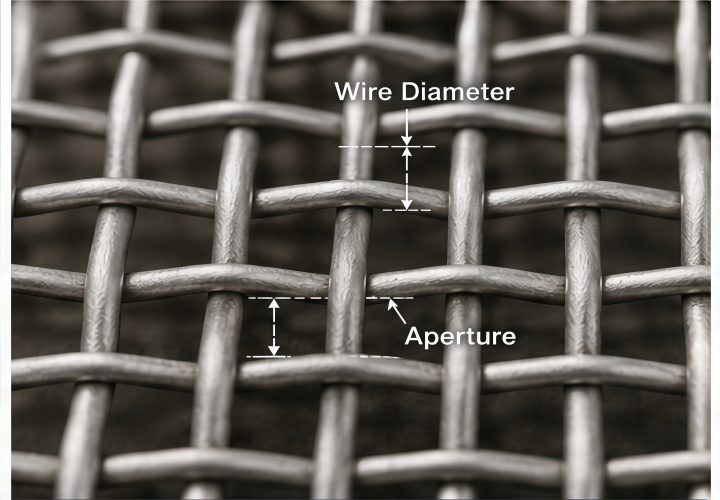
For standardized particle size analysis, the nominal aperture and applicable sieve standard should be confirmed rather than relying on mesh number alone.
What Is a Micron?
A micron (μm) is one thousandth of a millimeter.
1 mm = 1000 μm
Common fine sieve openings include 75 μm, 45 μm, and 38 μm. Micron values are useful when specifying fine powder and small-particle testing.
Mesh Size and Aperture Reference
The following values provide a practical reference for commonly used laboratory sieve sizes.
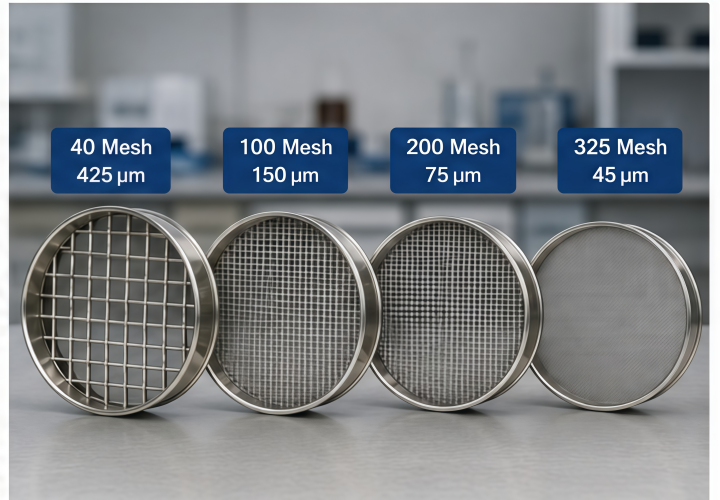
| ASTM Sieve Designation | Nominal Aperture | Aperture (μm) |
|---|---|---|
| No. 4 | 4.75 mm | 4750 |
| No. 10 | 2.00 mm | 2000 |
| No. 20 | 850 μm | 850 |
| No. 40 | 425 μm | 425 |
| No. 60 | 250 μm | 250 |
| No. 100 | 150 μm | 150 |
| No. 200 | 75 μm | 75 |
| No. 230 | 63 μm | 63 |
| No. 325 | 45 μm | 45 |
| No. 400 | 38 μm | 38 |
These values are a reference only. When testing must meet a defined standard, confirm the nominal aperture, sieve designation, wire characteristics, construction, and applicable tolerances from that standard.
ASTM E11-24 specifies requirements for woven wire test sieve cloth and test sieves, including aperture specifications, construction, and inspection.
Why Is Aperture More Important Than Mesh Number?
Mesh number is convenient for general identification, but aperture is more directly related to particle separation.
Suppose a laboratory needs to separate particles around 75 μm. The key specification is the required nominal aperture of 75 μm. The appropriate sieve designation can then be confirmed according to the applicable standard.
This distinction becomes increasingly important for fine powders, where small differences in opening size can affect test results.
A practical selection sequence is:
Current technical guidance on woven wire sieving likewise recommends selecting the opening size by the required aperture rather than relying only on mesh number because wire diameter affects the actual opening.
How to Choose the Right Wire Mesh Test Sieve?
1. Define the Target Particle Size
Determine the particle-size range that needs to be measured and whether the test requires a single size limit or a complete particle-size distribution.
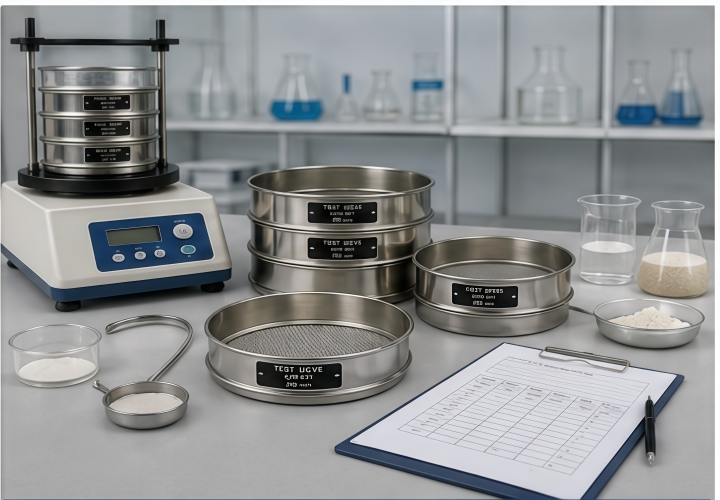
For distribution testing, several sieves with progressively smaller apertures can be stacked together.
2. Select the Nominal Aperture
Choose the opening according to the required particle-size separation.
For example, if the critical separation size is approximately 75 μm, specify a 75 μm nominal aperture and then confirm the corresponding designation under the required standard.
3. Confirm the Sieve Standard
The applicable test method should determine the standard.
When a test method specifies a particular standard, its aperture and construction requirements should take priority.
4. Choose the Sieve Diameter
Sieve diameter affects screening area, sample capacity, and compatibility with the sieve shaker.
Common laboratory diameters include 75 mm, 100 mm, 200 mm, and 300 mm.
| Sieve Diameter | Typical Use |
|---|---|
| 75 mm | Small samples and compact testing |
| 100 mm | Small laboratory samples |
| 200 mm | Routine laboratory particle analysis |
| 300 mm | Larger samples and greater screening area |
The appropriate diameter depends on sample quantity, laboratory workflow, and equipment compatibility.
5. Select the Mesh and Frame Material
Stainless steel woven mesh is commonly used for laboratory testing because of its corrosion resistance, durability, dimensional stability, and ease of cleaning.
The frame should hold the mesh securely and maintain the required geometry during repeated testing.
6. Check Sieve Shaker Compatibility
Before purchasing, confirm the sieve diameter, number of sieve layers, stack configuration, sample quantity, and shaker compatibility.
A sieve that meets the aperture requirement but does not match the testing equipment may not be practical to use.
Example: How to Select a 75 μm Test Sieve
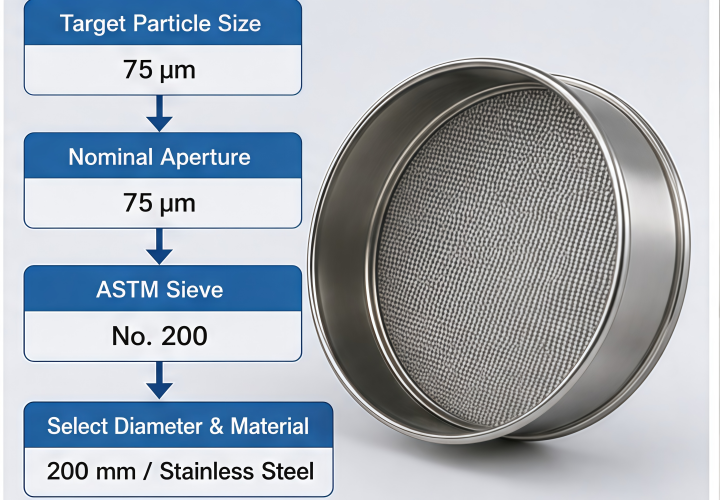
Suppose a laboratory needs to evaluate powder with a critical separation size of approximately 75 μm.
A suitable specification would begin with:
The important point is that selection starts with the required aperture. The mesh number can then be used as a reference after the standard and opening have been confirmed.
Test Sieve Specification: What Should Be Checked?
| Specification | Purpose |
|---|---|
| Mesh Number | General mesh identification |
| Nominal Aperture | Defines the intended opening size |
| Wire Diameter | Defines wire construction and affects opening geometry |
| Mean Aperture | Indicates the average measured opening |
| Aperture Tolerance | Defines permitted variation from nominal size |
| Sieve Standard | Defines applicable construction and verification requirements |
For standardized particle size analysis, these specifications are more useful than relying on mesh number alone.
What Can Cause Inaccurate Sieve Analysis?
Inaccurate results can result from incorrect aperture selection, excessive sample loading, damaged mesh, blocked openings, or inconsistent sieving conditions.
Fine powders can also cause mesh blinding, reducing the effective screening area.
The sieve should be inspected regularly for broken wires, deformed openings, blocked mesh, corrosion, and frame damage. When controlled measurement accuracy is required, inspection or calibration should follow the applicable standard and laboratory quality system.
Inspection and Maintenance
Clean the sieve after each test using a method suitable for the material. Avoid hard or sharp tools that can deform the wire mesh.
For applications requiring controlled accuracy, inspection or calibration should be performed according to the applicable specification. ASTM E11 includes inspection-related requirements for test sieve cloth and test sieves.
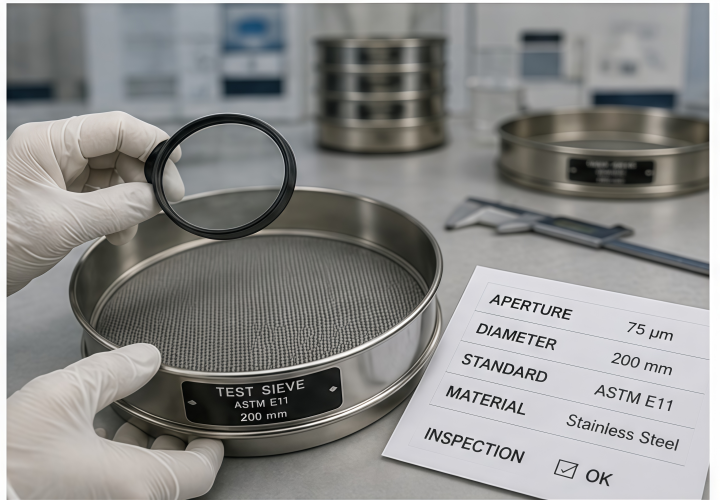
What Information Should You Provide When Ordering?
A complete specification helps the supplier recommend the correct configuration.
For example:
Dahan can recommend a suitable sieve configuration according to the required aperture, diameter, material, and testing standard.
Frequently Asked Questions
What is a wire mesh test sieve?
It is a laboratory sieve made with woven wire mesh and a rigid frame for separating particles according to size.
What is the difference between mesh size and aperture?
Mesh size generally describes the number of openings per linear inch, while aperture describes the specified clear opening between wires. Wire diameter also affects the resulting opening.
Does a higher mesh number mean a smaller opening?
Generally, yes. A higher mesh number normally corresponds to a smaller opening, but the exact aperture should be confirmed from the applicable sieve specification.
Should I order by mesh number or micron size?
For standardized testing, specify the nominal aperture and applicable standard whenever possible. Mesh number can be provided as a reference.
How do I choose the correct sieve diameter?
Choose the diameter according to sample quantity, required screening area, sieve stack configuration, laboratory workflow, and sieve shaker compatibility.
Need Help Choosing the Right Sieve Specification?
To select the appropriate wire mesh test sieve, provide the material, target particle-size range, nominal aperture, sieve diameter, applicable standard, sample quantity, and required quantity.
Dahan can help evaluate these requirements and recommend a suitable configuration for particle size analysis and laboratory quality control.
Do you want to know the output? model? price? Please click (inside product page) or online consultation to learn more.
Dahan can also customize it for you according to your needs. Come and get the design that suits you.
Kon Leung, Ph.D.
Staff Simulation Engineer at BISSELL Homecare, Inc.