What Size Soil Sieve Do I Need? A Complete Selection Guide
Wednesday September-09 2026 11:36:03
Soil Sieve Frame Diameter Selection (200mm / 300mm / 400mm)
Frame diameter determines screening area, sample loading capacity, and shaker compatibility. All sizes below comply with ASTM E11, ISO 3310-1, and AASHTO standards for geotechnical laboratory.
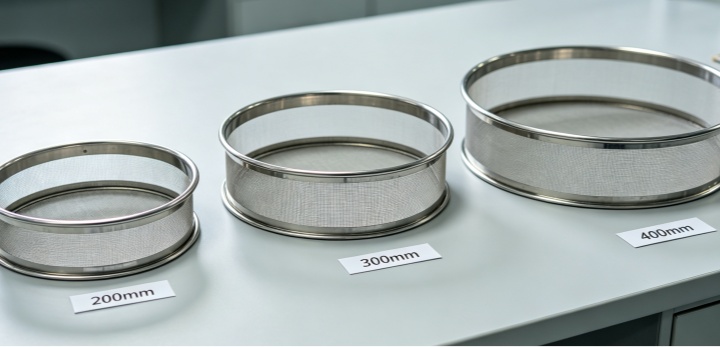
| Frame Diameter | Frame Height | Core Features | Best Application Scenarios |
| 200mm | 50mm | Compact size, full shaker compatibility, stable operation, cost-effective | Standard laboratory daily tests, small soil samples, fine-grained soil analysis, university and third-party lab routine detection |
| 300mm | 60mm | Larger screening area, higher sample tolerance, balanced efficiency & accuracy | Medium-volume soil samples, mixed coarse-fine soil grading, construction engineering and road foundation testing |
| 400mm | 65mm | Maximum screening area, supports heavy samples, no material overflow | Large-volume bulk samples, coarse gravel soil, aggregate grading, mining and large infrastructure engineering testing |
Soil Type & Matching Sieve Aperture Guide
Different soil textures require specific aperture sizes to ensure complete particle separation and accurate gradation results. The table below provides standard matching rules for mainstream soil types.
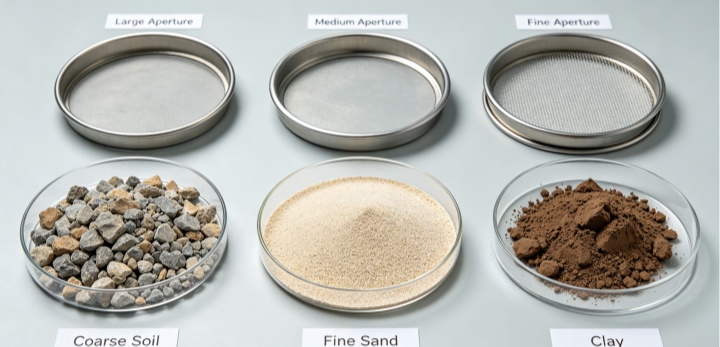
| Soil Type | Standard Recommended Apertures | Testing Requirements & Notes |
| Coarse-Grained Soil (Gravel, Coarse Sand) | 60mm, 40mm, 20mm, 10mm, 5mm, 2mm | Used for initial large-particle removal and aggregate grading; widely applied in roadbed and foundation engineering detection |
| Fine-Grained Soil (Silt, Fine Sand) | 1.0mm, 0.5mm, 0.25mm, 0.106mm | Core apertures for conventional soil particle classification, supporting detailed gradation data analysis and soil quality evaluation |
| Clay & Cohesive Fine Soil | 0.075mm (200 mesh) and ultra-fine apertures | Prone to agglomeration and mesh blinding; dry sieving matched with wet sieving is required for complete particle separation |
The Core Role of 200 Mesh (0.075mm) Soil Sieve
The #200 mesh sieve with a standard aperture of 0.075mm is the most critical ultra-fine specification in geotechnical testing and a must-have sieve for all professional soil analysis laboratories. It acts as the unified industry boundary for classifying fine soil powder and coarse particles.
Soil Sieve Mesh Material Comparison
Mesh material determines sieve durability, test accuracy, corrosion resistance and applicable scenarios. Choose materials based on test frequency, soil properties and budget via the comparison table below.
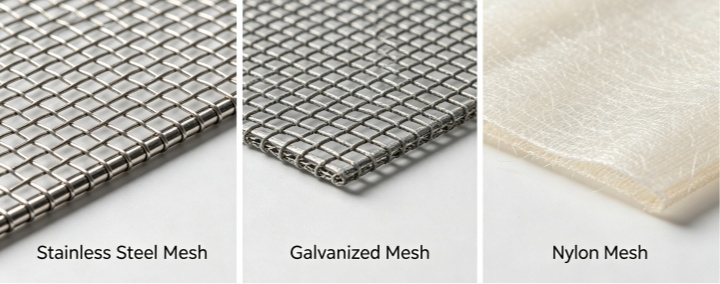
| Mesh Material | Advantages | Disadvantages | Applicable Scenarios |
| Stainless Steel (304/316L) | Rust-proof, acid & alkali resistant, non-deformable aperture, high precision, long service life, anti-blinding | Higher cost | Professional labs, high-precision repeated testing, slightly corrosive soil samples, long-term standard detection |
| Galvanized Wire Mesh | Low cost, basic rust resistance, good wear resistance for short-term use | Galvanized layer wears easily, prone to rust and aperture deviation after long-term use | Engineering field short-term tests, low-frequency routine detection, non-high-precision screening |
| Nylon Wire Mesh | Soft texture, no particle crushing, excellent anti-blocking performance for fine powder | Poor high-temperature and wear resistance, not suitable for coarse particles | Ultra-fine clay and powder soil testing, low-intensity fine particle screening |
Quick Soil Sieve Selection Cheat Sheet
Use this quick reference table to select the ideal soil sieve configuration for your testing needs in one click.
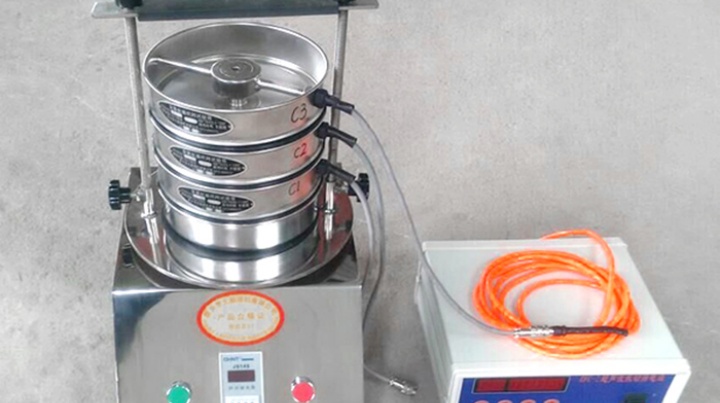
| Testing Scenario | Recommended Frame Diameter | Recommended Mesh Material | Must-Have Aperture |
| Daily lab routine test & small samples | 200mm | Stainless steel | 0.075mm (#200 mesh) |
| Engineering on-site medium-sample test | 300mm | Stainless steel / Galvanized | Full conventional aperture set |
| Large particle & bulk sample test | 400mm | Stainless steel | 2mm / 5mm / 10mm coarse apertures |
| Fine clay & ultra-fine soil analysis | 200mm | Nylon / Stainless steel | 0.075mm (#200 mesh) |
| Long-term high-precision lab testing | 200mm/300mm | Full stainless steel | Complete standard aperture set |
Final Thoughts
Accurate soil sieve selection is the first step to reliable geotechnical test data. Frame diameter matches sample volume and test efficiency, aperture size determines grading accuracy for different soil types, and mesh material affects service life and test standard compliance. Mastering the above selection rules can help laboratories and engineering teams avoid test errors caused by mismatched equipment, improve detection efficiency, and meet ASTM and ISO standard testing requirements.
For standard full-set soil sieves in 200mm/300mm/400mm diameters and custom aperture specifications, browse our soil sieve product range for high-precision, standard-compliant laboratory screening solutions.
Do you want to know the output? model? price? Please click (inside product page) or online consultation to learn more.
Dahan can also customize it for you according to your needs. Come and get the design that suits you.
Kon Leung, Ph.D.
Staff Simulation Engineer at BISSELL Homecare, Inc.