Dry Sieving vs Wet Sieving: Choosing the Best Method for Sub-45 Micron Powders
Wednesday September-09 2026 11:45:45
Particle size analysis for sub-45 micron fine powders is one of the most challenging testing procedures. Ultra-fine particles are prone to static adhesion, agglomeration, and mesh blinding, which often lead to inaccurate grading results if the wrong sieving method is adopted. Many laboratories struggle with inconsistent repeatability, false large-particle data, and frequent sieve blockages when testing powders below 45 μm.
The two mainstream testing solutions are dry sieving and wet sieving. Each method has unique advantages and inherent limitations for sub-45 micron materials. This article scientifically compares dry sieving and wet sieving based on actual laboratory application scenarios, helping engineers and lab technicians choose the most reliable powder testing method.
Basic Working Principles
Dry Sieving Principle
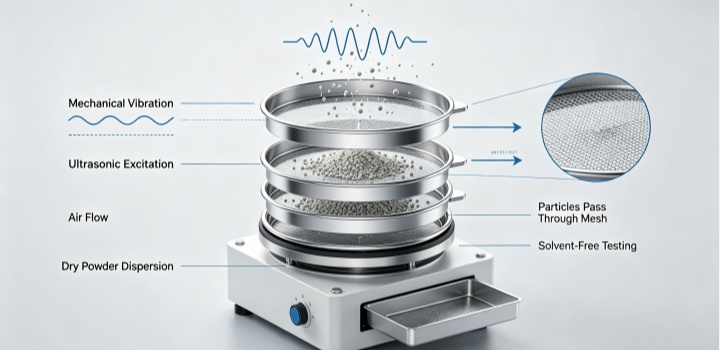
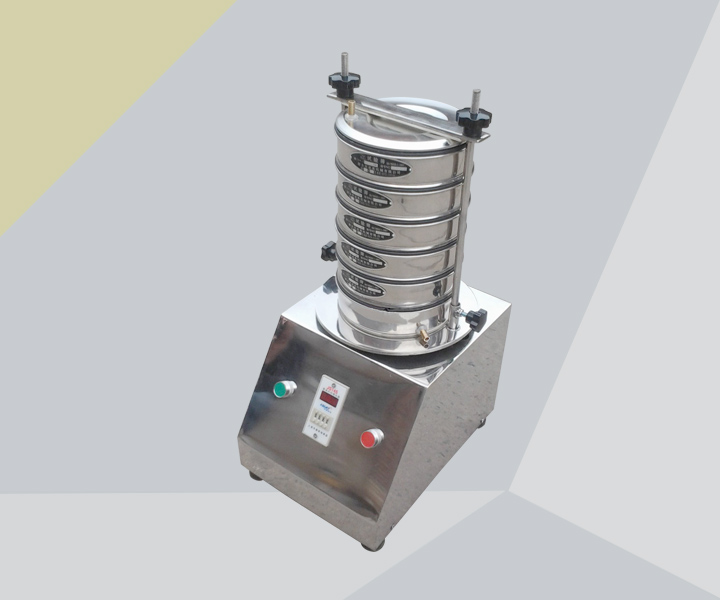
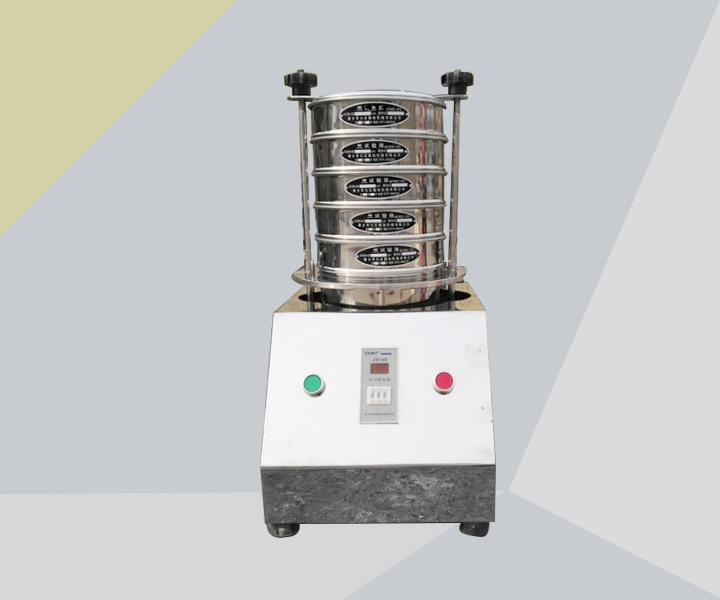
Dry sieving relies on mechanical vibration, ultrasonic excitation, or air flow to disperse dry powder particles. Particles smaller than the mesh size pass through the sieve opening by gravity and vibration. It is a fast, solvent-free testing method suitable for stable and non-agglomerative powder materials.
Wet Sieving Principle
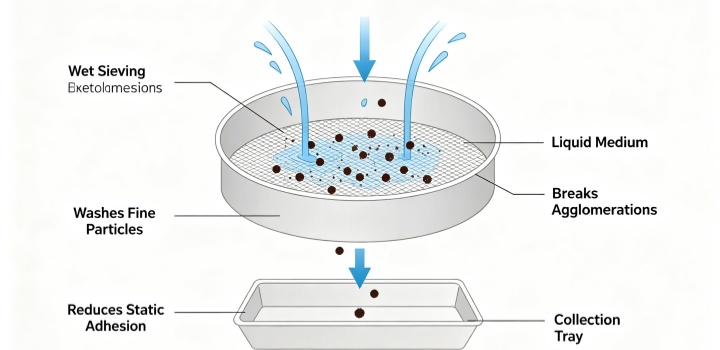
Wet sieving uses liquid medium (usually purified water or ethanol) to fully soak and disperse fine powder. The liquid flow breaks particle agglomerations and washes qualified fine particles through the sieve mesh. This method eliminates static interference and adhesion problems that commonly occur in sub-45 micron dry powder testing.
Comprehensive Comparison: Dry Sieving vs Wet Sieving (Sub-45μm Powders)
Dispersion Effect for Fine Powder| Comparison Item | Dry Sieving | Wet Sieving | |
| Dispersion Effect for Fine Powder | Poor; static and agglomeration serious below 45μm | Excellent; liquid completely breaks agglomerates | |
| Testing Repeatability | Low, easily affected by humidity and static | High, stable testing environment | |
| Mesh Blocking Risk | Very high for ultra-fine powder | Greatly reduced by liquid flushing | |
| Testing Speed | Fast, no drying required | Slow, requires cleaning and drying | |
| Sample Chemical Risk | No chemical reaction risk | Not suitable for water-soluble or swellable powder | |
| Post-test Maintenance Work | Moderate dust residue | Strict cleaning required to prevent mesh clogging |
Why Standard Dry Sieving Fails for Sub-45μm Powders
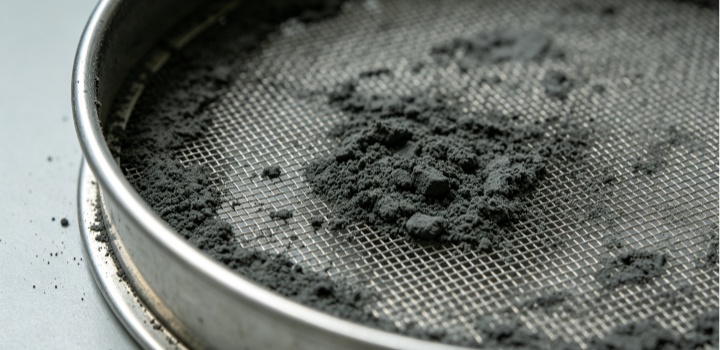
For conventional particle sieving above 100μm, dry sieving delivers fast and accurate results. However, when particle size drops below 45 microns, physical characteristics of ultra-fine powder change significantly:
First, sub-45μm particles produce strong static electricity during vibration, causing mutual adhesion and forming false large particles that cannot pass through the mesh normally.
Second, ultra-fine powder is easy to accumulate in the sieve mesh, resulting in mesh blinding. Once the mesh is blocked, subsequent particles cannot be screened normally, completely destroying test accuracy.
Third, powder agglomeration makes the actual screened particle size larger than the true particle size, resulting in serious test data deviation.
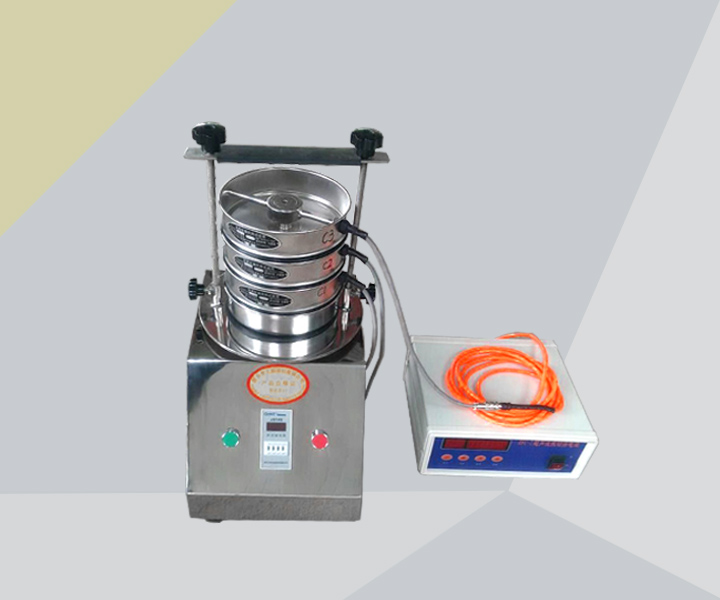
To solve these problems, ultrasonic-assisted dry sieving is widely used in modern laboratories to improve dispersion performance for fine powder dry testing.
When to Choose Wet Sieving for Sub-45μm Testing
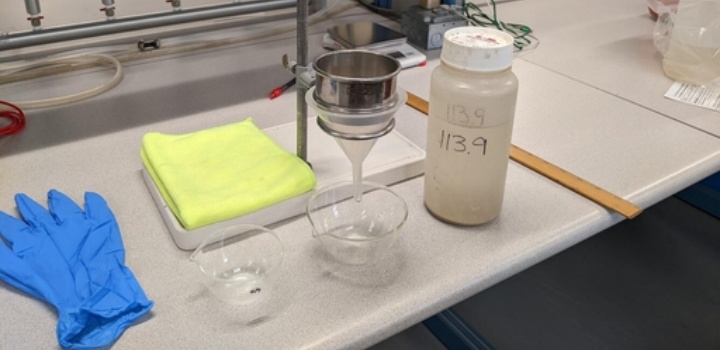
Wet sieving is the most reliable solution for ultra-fine powder in the following scenarios:
Powder materials that are easy to agglomerate and generate static electricity. Test scenarios requiring high data repeatability and accuracy. Fine powder with strong adhesion and high blanking difficulty. Strict laboratory standards for particle size classification below 45μm
It should be noted that wet sieving brings higher requirements for post-test sieve maintenance. Residual fine powder and liquid impurities easily block tiny mesh holes after wet testing. Standardized cleaning and maintenance procedures are essential to ensure long-term sieve accuracy and service life. You can follow the ultrasonic test sieve cleaning and maintenance SOP to complete standardized post-test processing and avoid mesh damage and cross-contamination.
When Dry Sieving Is Still Acceptable for Sub-45μm Powders
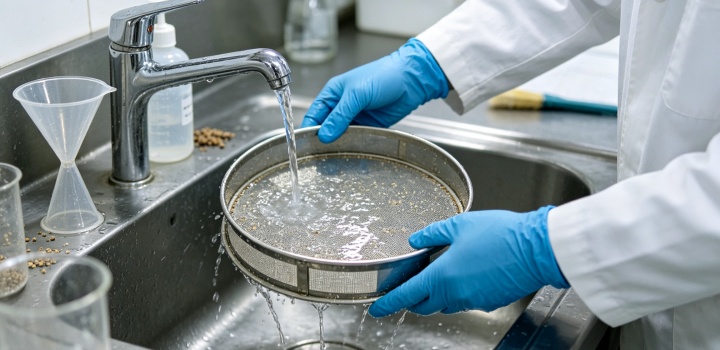
Although wet sieving has higher accuracy, dry sieving still has irreplaceable application value:
The sample is water-soluble, hygroscopic or chemically reactive with liquid.
Rapid screening and trend analysis are required without ultra-high precision.
Equipped with ultrasonic dispersion system to reduce agglomeration and static interference.
How to Choose: Final Laboratory Selection Guide
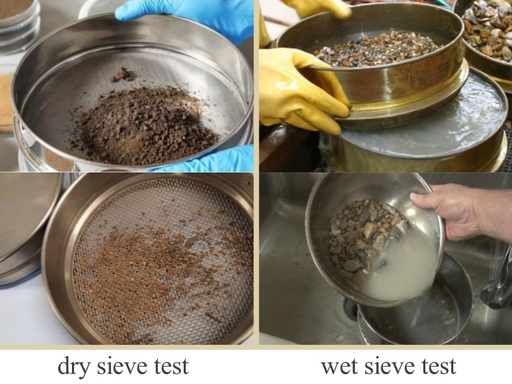
You can quickly determine the correct sieving method according to the following rules:
Choose Wet Sieving If: Your powder is ultra-fine, cohesive, static-prone, and requires precise and repeatable particle size data.
Choose Dry Sieving If: Your powder cannot contact liquid, or you need fast and efficient preliminary grading with ultrasonic auxiliary dispersion.
Conclusion
For sub-45 micron powder particle size analysis, there is no one-size-fits-all sieving method. Wet sieving dominates high-precision ultra-fine powder testing due to its excellent dispersion effect, while dry sieving is irreplaceable for special materials and rapid detection scenarios. Laboratories should match the sieving method according to powder physical properties, chemical characteristics and testing accuracy requirements. Reasonable equipment assistance and standardized sieve maintenance can further improve the stability and reliability of particle size testing results.
Do you want to know the output? model? price? Please click (inside product page) or online consultation to learn more.
Dahan can also customize it for you according to your needs. Come and get the design that suits you.
Kon Leung, Ph.D.
Staff Simulation Engineer at BISSELL Homecare, Inc.