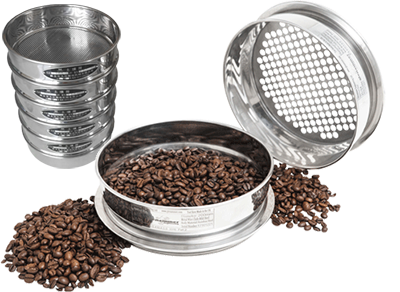
ASTM E11 Test Sieve Standard: Sizes, Apertures & Requirements
Friday August-21 2026 13:53:57
A practical reference covering ASTM E11-24 sieve sizes, nominal apertures, opening requirements, test sieve construction, frame dimensions, and inspection levels.
ASTM E11 is a specification for woven wire test sieve cloth and test sieves used to classify materials by particle size. ASTM E11-24 covers sieve cloth, test sieve construction, standard and non-standard frame sizes, and procedures for inspecting sieve cloth and completed test sieves. Its nominal aperture range extends from 125 mm to 20 μm.
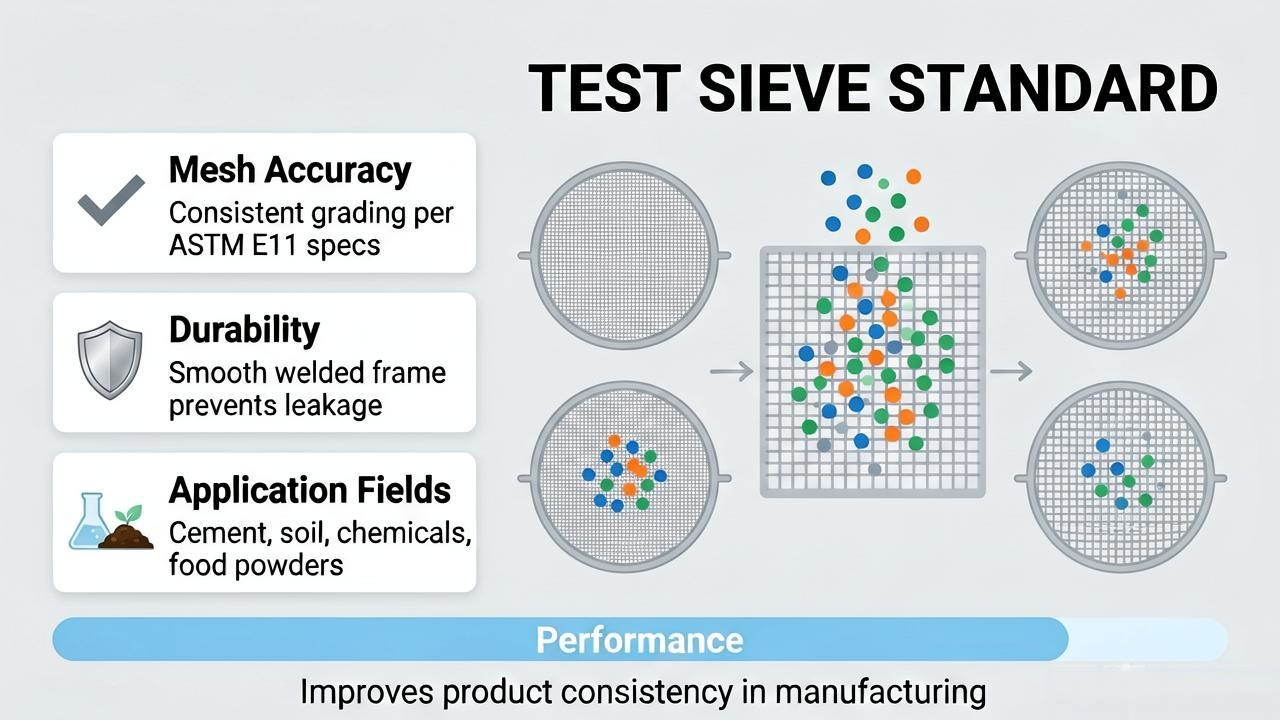
Understanding the ASTM E11 Test Sieve Standard helps laboratories select and specify test sieves according to sieve designation, nominal aperture, opening tolerances, frame construction, and inspection requirements.
01What Is the ASTM E11 Test Sieve Standard?
The ASTM E11 Test Sieve Standard defines technical requirements for woven wire test sieve cloth and test sieves used for particle-size classification.
Its scope includes the sieve cloth itself, test sieve construction, standard and non-standard test sieve frame sizes, and procedures for inspecting sieve cloth and completed test sieves. ASTM E11-24 applies to sieve cloth with nominal apertures ranging from 125 mm down to 20 μm.
Therefore, ASTM E11 is not simply a reference for mesh numbers. It also establishes requirements related to sieve openings, construction, frame characteristics, and inspection.
02ASTM E11 Sieve Sizes and Nominal Apertures
A key part of the ASTM E11 Test Sieve Standard is the nominal aperture. It represents the designated opening size of the sieve cloth and provides the primary reference for particle-size separation.
ASTM E11-24 covers nominal apertures from 125 mm to 20 μm, providing sieve sizes for a wide range of coarse and fine particle-size analyses.
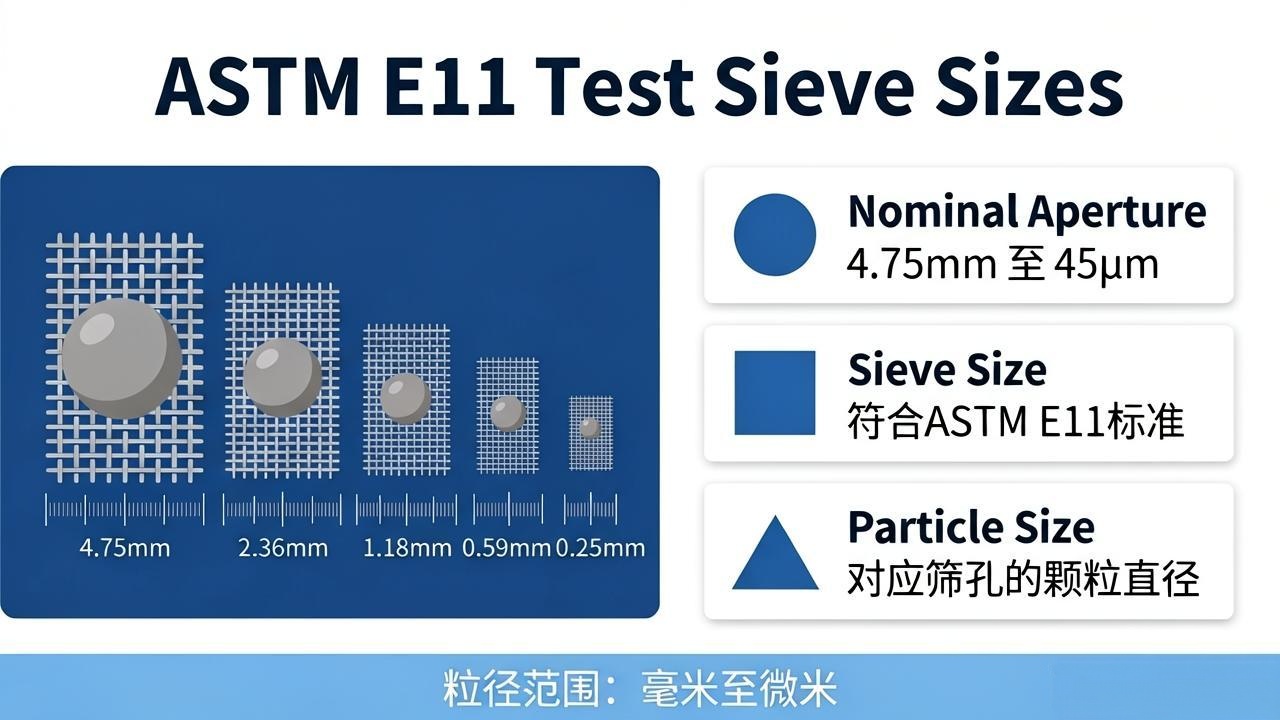
Common ASTM E11 Sieve Sizes
Common sieve designations and nominal apertures include:
| Sieve Designation | Nominal Aperture |
|---|---|
| No. 4 | 4.75 mm |
| No. 10 | 2.00 mm |
| No. 20 | 850 μm |
| No. 40 | 425 μm |
| No. 60 | 250 μm |
| No. 100 | 150 μm |
| No. 200 | 75 μm |
These examples show how a sieve designation corresponds to a nominal aperture. When a test method specifies an ASTM E11 sieve, the required designation and nominal aperture should be considered together rather than selecting a sieve based only on a general mesh description.
For a particle-size analysis, the appropriate sieve is normally determined by the aperture required by the applicable test method. A series of sieve designations may be selected when several particle-size intervals need to be measured.
03ASTM E11 Sieve Number and Aperture Size
A sieve number identifies a particular sieve designation, while nominal aperture describes the opening dimension.
Example
For example, a No. 100 sieve has a nominal aperture of 150 μm, while a No. 200 sieve has a nominal aperture of 75 μm.
Mesh terminology alone does not fully describe an ASTM E11 sieve because the specification also considers wire characteristics, opening dimensions, and permitted opening variation. For laboratory work, the sieve designation and nominal aperture should therefore be specified together.
View ASTM E11 Aperture Requirements
04ASTM E11 Aperture Requirements
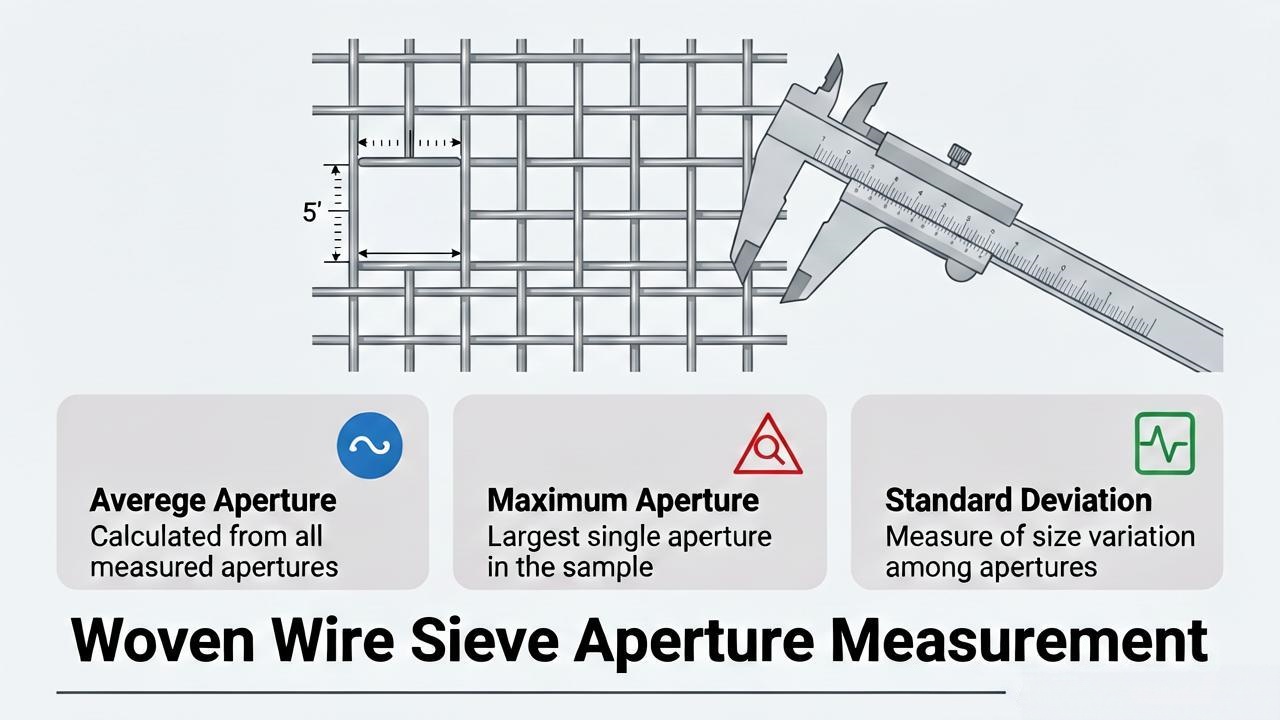
The ASTM E11 Test Sieve Standard does not define a sieve only by its nominal aperture. ASTM E11-24 specifies three important characteristics for sieve-cloth openings:
These requirements help evaluate both the size and uniformity of openings in the sieve cloth.
Average Aperture
Average aperture represents the overall opening size determined from measured openings across the sieve cloth.
Multiple opening measurements provide a more representative evaluation than relying on a single opening. The measured average is compared with the applicable requirement for the specified nominal aperture.
Maximum Aperture
Maximum aperture controls the largest permitted individual opening under the applicable ASTM E11 requirements.
This requirement is important because an unusually large opening could allow particles larger than the intended separation size to pass through the sieve.
Maximum Standard Deviation
Maximum standard deviation addresses the statistical variation among measured openings.
It provides an indication of opening uniformity across the sieve cloth. ASTM E11-24 applies statistical techniques to the evaluation of opening variation and specifies the applicable maximum standard deviation requirements.
As a result, conformity with ASTM E11 cannot be determined from nominal aperture alone. The measured openings must satisfy the applicable requirements for average aperture, maximum aperture, and statistical variation.
View ASTM E11 Test Sieve Construction
05ASTM E11 Test Sieve Construction
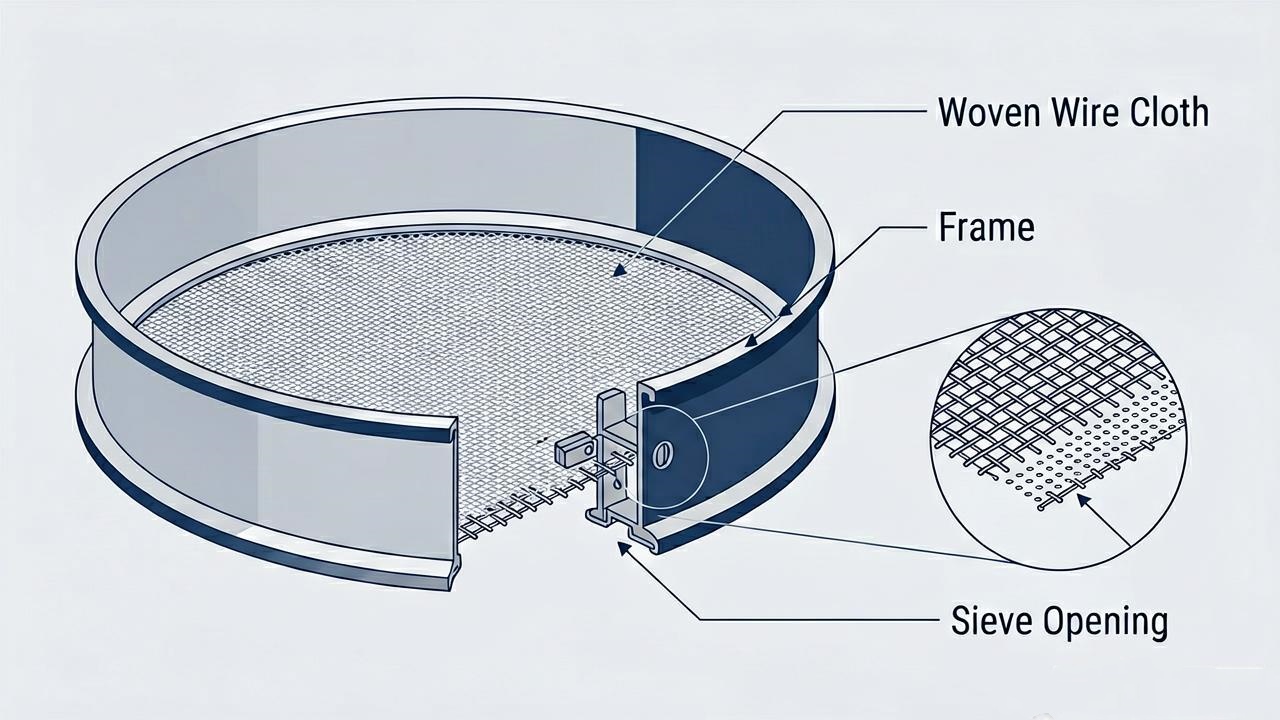
The ASTM E11 Test Sieve Standard also covers the construction of test sieves using woven wire cloth mounted in a frame.
Woven Wire Sieve Cloth
Woven wire cloth forms the particle-sizing surface of the test sieve. Its opening dimensions and wire characteristics directly affect particle separation.
The cloth must be properly supported and attached so that its intended opening characteristics are maintained during handling and testing.
Frame and Cloth Attachment
The sieve frame provides structural support for the cloth. The frame should be rigid, while the cloth should be mounted without distortion, looseness, or waviness.
The connection between the cloth and frame should also prevent material from becoming trapped at the joint. These construction characteristics are part of the ASTM E11 requirements for test sieve assemblies.
View ASTM E11 Standard and Non-Standard Sieve Frames
06ASTM E11 Standard and Non-Standard Sieve Frames
ASTM E11 covers both standard and non-standard test sieve frame sizes. Standard frames are circular and follow defined dimensional requirements, while non-standard frames can have other configurations when applicable.
Typical Frame Diameters
Typical standard frame diameters historically specified for ASTM E11 include 3, 6, 8, 10, and 12 in., corresponding approximately to 76, 152, 203, 254, and 305 mm.
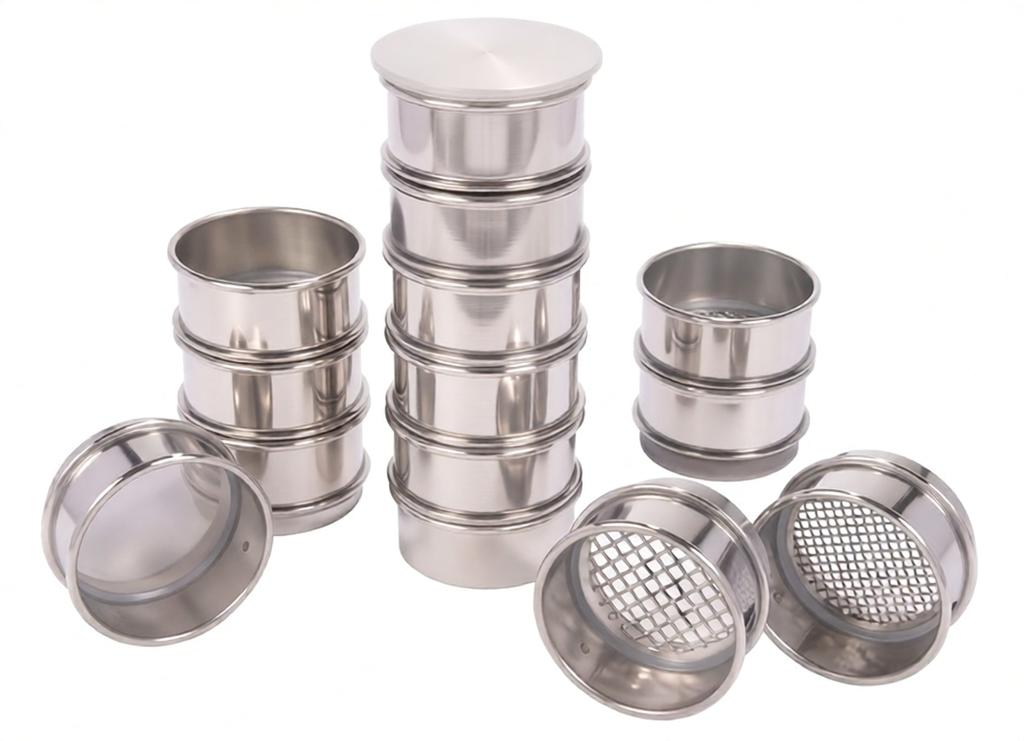
The frame must provide adequate support for the sieve cloth and allow compatible sieves to be stacked or used with the appropriate accessories. Frame construction, dimensions, materials, and cloth attachment are all relevant to test sieve conformity.
For laboratory documentation, frame diameter should therefore be specified together with sieve designation and nominal aperture.
View ASTM E11 Sieve Inspection and Quality Levels
07ASTM E11 Sieve Inspection and Quality Levels
ASTM E11-24 applies three different sampling confidence levels to Compliance, Inspection, and Calibration Test Sieves. Calibration Test Sieves have at least twice as many openings measured as Inspection Test Sieves.
| Sieve Type | Main Purpose |
|---|---|
| Compliance | Establish conformity with applicable requirements |
| Inspection | Provide a higher sampling confidence level |
| Calibration | Provide more extensive opening measurement |
Important Distinction
These are not different aperture grades. The distinction is primarily related to inspection confidence and the amount of opening measurement performed.
Aperture Measurement and Evaluation
Inspection involves measuring multiple sieve openings and evaluating the results against the applicable ASTM E11 requirements.
The evaluation considers characteristics such as average aperture, maximum permitted opening, and statistical variation. ASTM E11-24 includes an Annex describing procedures for inspecting sieve cloth and test sieves to determine whether they comply with the specification.
This makes inspection more than a simple check of the sieve label or nominal mesh designation.
08How to Read an ASTM E11 Test Sieve Specification?
A test sieve specification can combine the applicable standard, sieve designation, nominal aperture, and frame diameter.
For example:
ASTM E11 identifies the applicable specification.
No. 100 identifies the sieve designation.
150 μm indicates the nominal aperture.
8 in. identifies the nominal frame diameter.
Using these elements together provides a more complete description than referring to a sieve only by a mesh number.
09ASTM E11 Test Sieve Standard Quick Reference
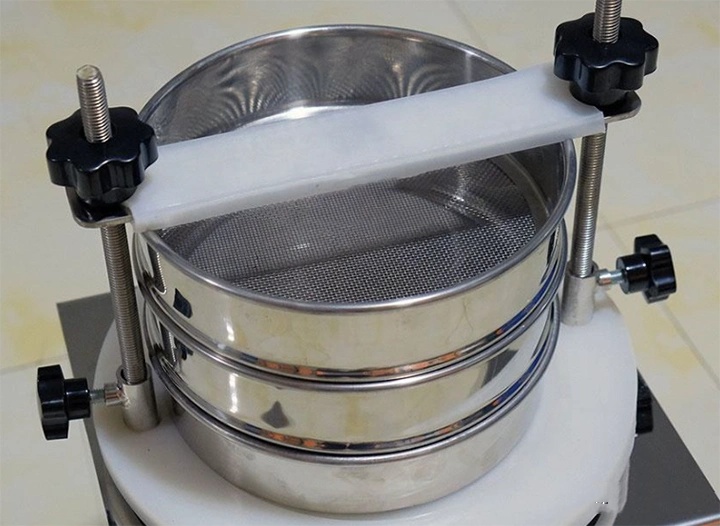
| Item | ASTM E11 Reference |
|---|---|
| Current specification | ASTM E11-24 |
| Nominal aperture range | 125 mm–20 μm |
| Sieve medium | Woven wire cloth |
| Opening requirements | Average, maximum, and maximum standard deviation |
| Frame types | Standard and non-standard |
| Inspection | Sieve cloth and test sieve |
| Quality levels | Compliance, Inspection, and Calibration |
The ASTM E11 Test Sieve Standard therefore covers sieve openings, construction, frame requirements, and inspection in addition to sieve designation.
View Frequently Asked Questions
10Frequently Asked Questions
What aperture range does ASTM E11 cover?
ASTM E11-24 covers nominal sieve-cloth apertures from 125 mm down to 20 μm.
What is the difference between Compliance, Inspection, and Calibration Test Sieves?
They represent different sampling confidence levels used when evaluating sieve openings. Calibration Test Sieves involve at least twice as many measured openings as Inspection Test Sieves, providing more extensive measurement information.
View Where to Find ASTM E11 Test Sieves
11Where to Find ASTM E11 Test Sieves?
ASTM E11 Compliance Laboratory Test Sieves
Laboratories requiring test sieves manufactured according to ASTM E11 requirements can review ASTM E11 compliance laboratory test sieves for available aperture ranges, frame sizes, materials, and documentation options.
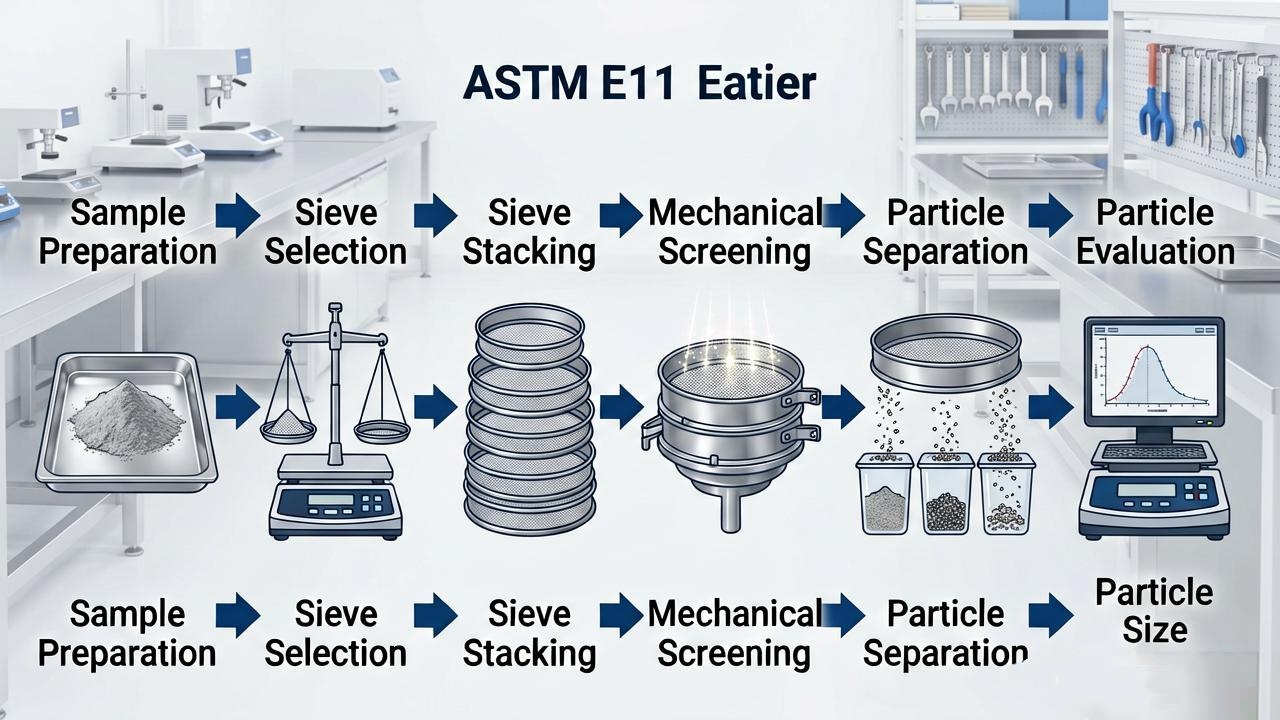
Dahan provides ASTM E11 test sieve configurations for laboratories that need to match a defined sieve designation, aperture, and frame specification.
12Conclusion
The ASTM E11 Test Sieve Standard defines requirements for woven wire sieve cloth, nominal apertures, opening tolerances, test sieve construction, frame sizes, and inspection procedures. ASTM E11-24 covers nominal apertures from 125 mm to 20 μm.
For particle-size analysis, the sieve designation, nominal aperture, opening requirements, frame configuration, and applicable inspection level should be considered together when specifying a test sieve.
Do you want to know the output? model? price? Please click (inside product page) or online consultation to learn more.
Dahan can also customize it for you according to your needs. Come and get the design that suits you.
Kon Leung, Ph.D.
Staff Simulation Engineer at BISSELL Homecare, Inc.