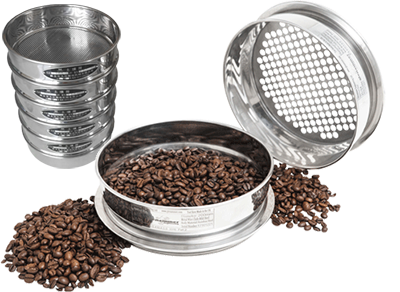
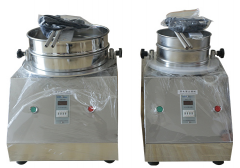
Test Sieve Shaker Machine for Particle Size Analysis
The Test Sieve Shaker Machine is a laboratory screening machine for particle size analysis of powders and granular materials. It uses controlled vertical mechanical vibration to move material through a stack of test sieves and separate different particle-size fractions.
Available in DH-75, DH-100, DH-200 and DH-300 configurations, it is suitable for laboratory testing, routine sieve analysis and quality control.
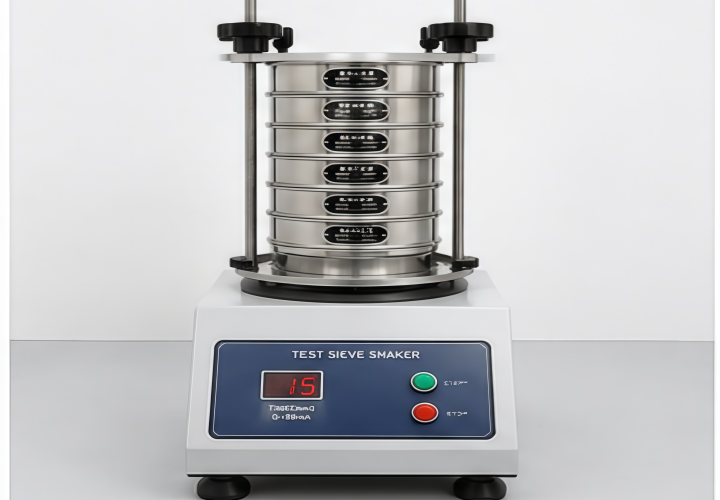
Key Specifications of Test Sieve Shaker Machine
| Parameter | Specification |
|---|---|
| Product Name | Test Sieve Shaker Machine |
| Model | DH-75 / DH-100 / DH-200 / DH-300 |
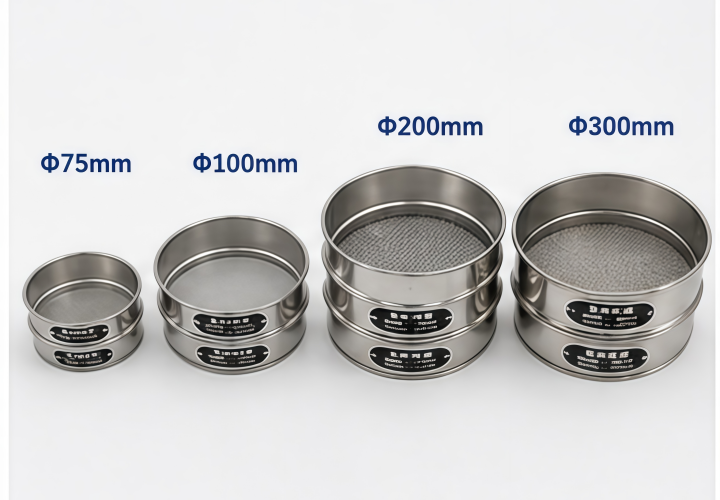
| Compatible Sieve Diameter | Φ75 / Φ100 / Φ200 / Φ300 mm |
| Standard Screening Size | 0.038–3 mm |
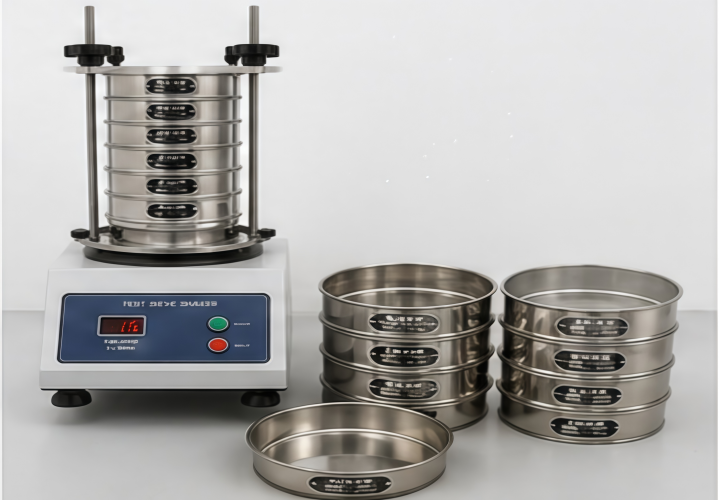
| Sieve Layers | Up to 8 layers, including receiving pan |
| Feeding Amount | ≤200 g per batch |
| Amplitude | ≤5 mm |
| Vibration Source | YZU vertical vibration motor |
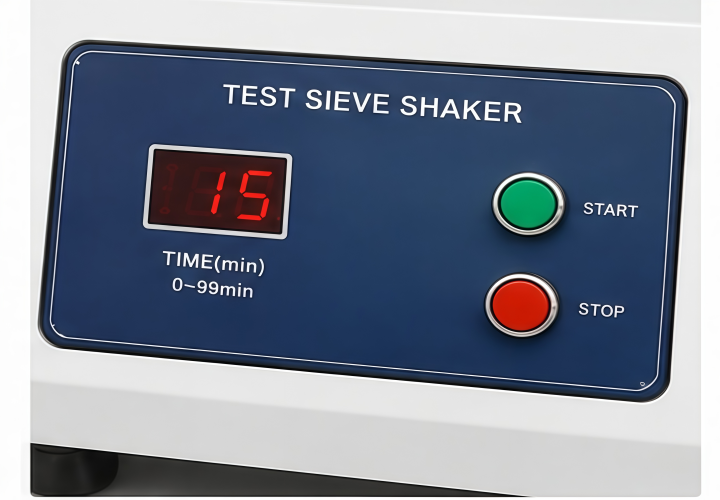
| Timer | 0–99 min |
| Noise Level | ≤50 dB |
| Voltage | 220 V, or as required |
| Power | 0.125 kW |
| Overall Dimensions | 360 × 300 × 736 mm |
| Standard Sieve Frame | SUS304 stainless steel |
| Sieve Frame Wall Thickness | 0.6 mm |
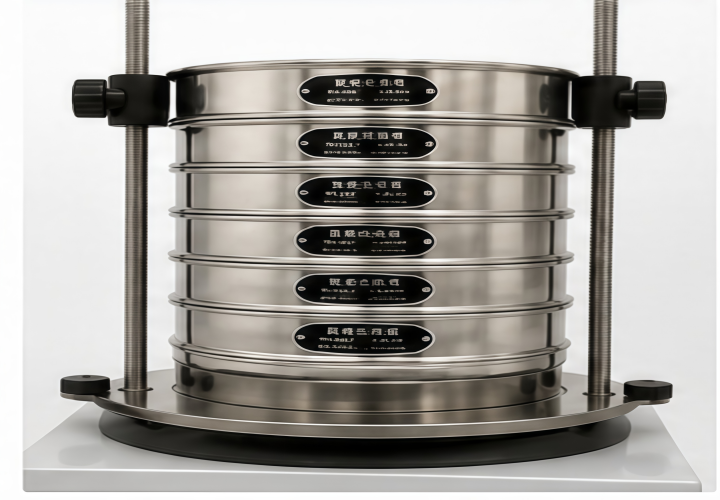
The appropriate sieve diameter and aperture should be selected according to the sample and testing requirements.
For standardized laboratory testing, the shaker can be supplied with compatible [standard test sieves] and stainless steel test sieves.
How Does a Test Sieve Shaker Machine Work?
The machine separates particles by size through controlled mechanical vibration.
1. Prepare the Sieve Stack
Arrange the test sieves from larger to smaller aperture and place the receiving pan underneath.
2. Add the Sample
Place the representative sample into the upper sieve.
3. Set the Screening Time
Set the timer according to the material and testing procedure.
4. Start the Machine
The YZU vertical vibration motor transfers mechanical movement to the sieve stack. Smaller particles pass through the appropriate apertures while larger particles remain on the corresponding sieve.
5. Evaluate the Results
The material retained on each sieve can be weighed to determine the particle-size distribution.
Key Features and Benefits
Multi-Layer Screening
The multi-layer configuration allows several particle-size fractions to be separated in one screening cycle.
Compact Laboratory Design
The compact structure is suitable for laboratories where installation space is limited.
Controlled Screening Time
The 0–99 minute timer provides a defined screening period for different testing procedures.
Stable Vertical Vibration
The YZU vertical vibration motor provides the mechanical movement required for sieve analysis, with an amplitude of up to 5 mm.
Stainless Steel Sieve Compatibility
The machine is compatible with Φ75, Φ100, Φ200 and Φ300 mm test sieves. Standard sieve frames are available in SUS304 stainless steel.
Low Operating Noise
The standard noise level is ≤50 dB, supporting routine laboratory operation.
Applications of Test Sieve Shaker Machine
Powder and Granular Material Testing
The machine can separate suitable dry powders and granular materials into different size fractions for particle-size analysis.
Chemical and Food Materials
It can be used for particle-size testing of suitable dry chemical powders, food ingredients and granular raw materials.
Mineral and Construction Materials
Suitable dry mineral and construction-related materials can be evaluated through laboratory sieve analysis.
Research and Quality Control
The machine is suitable for routine testing, incoming material inspection, product development and laboratory quality control.
How to Choose a Test Sieve Shaker Machine?
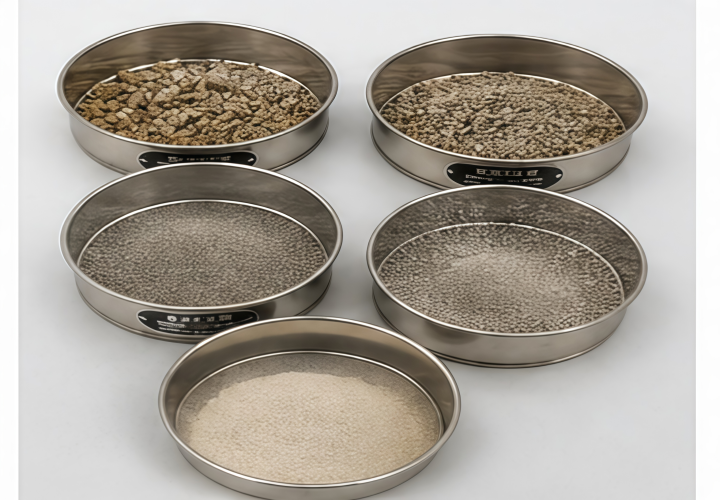
The correct configuration depends on the sample, sieve system and testing procedure.
Particle Size
Determine the particle-size range to be measured and select test sieves with suitable apertures.
Sieve Diameter
Choose the machine according to the diameter of the test sieves used in your laboratory.
Number of Sieve Layers
Use a multi-layer stack when several particle-size fractions need to be separated in one cycle.
Sample Quantity
The standard feeding amount is ≤200 g per batch.
Testing Standard
When a specific testing standard is required, select the appropriate test sieve first and then match the shaker to its diameter and configuration.
For standardized applications, see our [ASTM E11 Test Sieve] and related laboratory test sieve products.
Material Characteristics
Moisture, density, particle shape and cohesion can affect screening performance. Fine powders with severe mesh blocking may require an [Ultrasonic Sieve Shaker].
Example Configuration
Material: Dry powder
Sample Quantity: 100–200 g
Sieve Diameter: Φ200 mm
Sieve Layers: 4–6 layers
Testing Purpose: Particle-size distribution
A DH-200 configuration can be considered for this laboratory application together with the required test sieve set. Final selection should be confirmed according to the actual material and testing procedure.
Compatible Test Sieves and Standards
The Test Sieve Shaker Machine can be used with laboratory test sieves selected according to sieve diameter, aperture and testing requirements.
Stainless steel woven wire test sieves are commonly used for routine particle-size analysis. Other sieve types can be selected for specific applications.
The shaker provides the controlled movement, while the test sieve determines the separation aperture.
Test Sieve Shaker Machine vs. Other Sieve Shakers
| Sieve Shaker Type | Main Technology | Typical Application |
|---|---|---|
| Test Sieve Shaker Machine | Vertical mechanical vibration | Routine particle size analysis |
| Electromagnetic Sieve Shaker | Electromagnetic vibration | Controlled laboratory testing |
| Ultrasonic Sieve Shaker | Ultrasonic deblinding | Fine powders and mesh blocking |
| Mechanical / Ro-Tap Type | Mechanical motion with tapping | Specific mechanical screening |
A standard Test Sieve Shaker Machine is suitable for routine particle-size analysis using compatible test sieves.
For different excitation methods or difficult fine powders, see our [Electromagnetic Sieve Shaker] and [Ultrasonic Sieve Shaker] solutions.
Customization and Technical Support
The machine can be configured according to sieve diameter, sieve arrangement, power supply and testing requirements.
Dahan can provide technical assistance with sieve selection and machine configuration.
For a quotation, provide:
Material: Material to be tested.
Particle-Size Range: Approximate minimum and maximum particle size.
Sieve Diameter: Required sieve diameter.
Sieve Layers: Required number of layers.
Sample Quantity: Typical sample weight per test.
Power Supply: Available voltage and frequency.
Testing Standard: Required standard, if applicable.
Frequently Asked Questions
What is a Test Sieve Shaker Machine used for?
It is used to separate powders and granular materials into different particle-size fractions for laboratory particle-size analysis and quality control.
How many test sieves can the machine hold?
The standard configuration supports up to 8 layers including the receiving pan.
What sieve diameters are available?
The standard models are compatible with Φ75, Φ100, Φ200 and Φ300 mm test sieves.
What is the standard screening size?
The standard laboratory configuration is specified for a screening size of 0.038–3 mm. The applicable testing range also depends on the selected test sieve and material.
What is the maximum feeding amount?
The standard feeding amount is ≤200 g per batch.
What is the screening time range?
The built-in timer can be adjusted from 0 to 99 minutes.
Can the machine be customized?
Yes. Configuration can be selected according to sieve diameter, power supply and specific laboratory testing requirements.
What information is needed for a quotation?
Provide the material, particle-size range, sieve diameter, number of sieve layers, sample quantity, power supply and testing standard.
Request a Quote for Test Sieve Shaker Machine
Looking for a Test Sieve Shaker Machine for laboratory particle size analysis?
Send us your material and testing requirements. We can recommend a suitable sieve diameter, sieve arrangement and machine configuration.
Material:
Particle-size range:
Sieve diameter:
Number of sieve layers:
Sample quantity:
Voltage and frequency:
Testing standard or application: